
Dragon Bedtime Stories — Personalised for Your Household

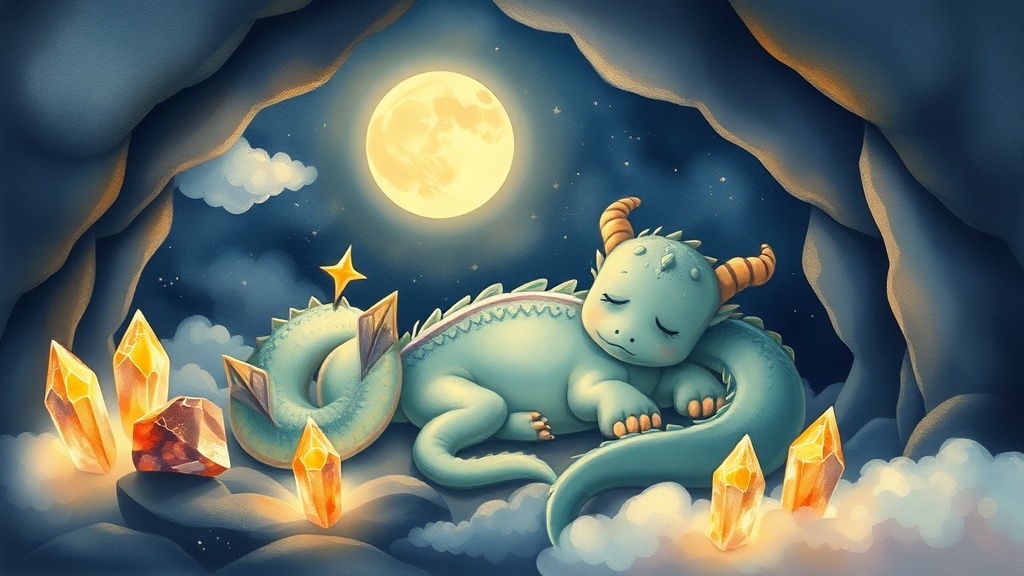
Dragons are the best kind of bedtime character. Big enough to be brave, small enough to hold. Fierce enough to feel like magic, gentle enough to land a child softly into sleep.

At Dreamtime, every dragon story is calibrated to your child's age and woven through with the values you've picked — courage, kindness, patience. A lost dragon in a garden. A wingbeat past sleeping rooftops. A mother dragon's quiet thanks before the story ends. The child is the listener, not a character — listening in, night after night, to a cast they grow attached to.

Here's the kind of story Dreamtime writes. Your child will hear a fresh one tonight — maybe about one of these characters, maybe about someone new from the recurring cast.

Generate dragon story — free

Takes 30 seconds. Calibrated to your child's age. Ready to read tonight.

A friendly emerald dragon in a garden — a watercolour bedtime illustration.

Why kids love dragons at bedtime

Dragons sit in the sweet spot of children's imaginations. They're magical without being delicate, powerful without being scary when written with care. For a 3-year-old, a tiny emerald dragon cupped in a hand is wonder made small. For a 7-year-old, riding a dragon through the night sky is freedom and bravery rolled together.

There's also something quietly developmental about dragon stories at bedtime. Kids learning to feel big emotions — anger, courage, the need to be brave — often find those feelings modelled safely in a dragon's arc. A dragon who was scared, who got lost, who was helped home by a kind character the listener can root for.

And dragons, when handled gently, teach kindness. A lost dragon doesn't need conquering. It needs finding, feeding, hugging, and flying home. That's a bedtime message most parents can get behind — even at 8.47pm after a long day.

Three sample stories

A taste of tonight’s story

Here's the kind of story Dreamtime writes. Your child will hear a fresh one tonight — maybe about one of these characters, maybe about someone new from the recurring cast.

A sunlit cottage garden in early spring, neat rows of leafy carrot tops growing in dark fertile soil, a low weathered st…

The Dragon Who Rode the Seasons Home

Mara was pulling up carrots in her garden when she heard a sound like a tiny sneeze.

She looked down. Sitting in the dirt between two carrot tops was the smallest dragon she had ever seen — which was saying something, because she had never seen a dragon at all. It was no bigger than a teacup. Its scales were the colour of a fresh leaf, bright emerald green, and it had golden eyes no larger than two apple seeds.

It sneezed again.

"Bless you," said Mara, because it seemed like the right thing to say.

The dragon looked up at her. "Thank you," it said, in a voice like a very small bell. "I am Pip, and I am quite lost."

Mara crouched down slowly so as not to frighten it. "Lost from where?"

"From the train," said Pip. "The train that goes between seasons. My mother rides it every year to bring spring to cold places. I fell off somewhere near autumn and now I cannot find the station."

Mara had not known there was a station. But she had sometimes noticed, at the bottom of the lane, a narrow door set into an old stone wall, painted the colour of rust.

"I think," she said carefully, "I might know where that is."

She held out her hand. Pip stepped onto her palm, delicate as a moth, and curled its tail neatly around her thumb.

They walked to the end of the lane together. The rust-coloured door was there, just as Mara remembered. When she pushed it open, warm air rushed through — golden and smelling of bonfires and apples, which was strange, because on Mara's side of the door it was a cool spring morning.

Beyond the door sat a train. It was long and green, with windows full of moving light — amber through one, pale blue through another, blinding white through a third. A conductor in a coat the colour of bark stood on the platform.

"One passenger returning," the conductor said, nodding at Pip.

Pip lifted its head and sniffed the air. Then it made a sound Mara had not heard before — a low, humming purr, like a kettle just beginning to warm. "She is on the train," Pip said. "I can smell her. She smells like warm rain."

Pip stepped off Mara's palm and onto the platform. Then it paused and looked back.

"You were very kind," it said. "I hope your carrots grow large."

Mara smiled. "I hope your mother isn't too worried."

Pip's golden eyes went soft. Then it turned and trotted up the steps of the green carriage and disappeared inside.

The door in the wall swung shut on its own, slowly and without a sound.

Mara stood in the lane for a moment. The spring morning was exactly as she had left it — cool and bright, the smell of damp soil on her hands. She looked down at her palm, where a tiny scorch mark, no wider than a fingernail, glowed faintly like a last ember.

She closed her fingers around it and walked home.

A wide high mountain pass at dawn, smooth carved stones piled into small cairns along a winding path, tough little flowe…

The Dragon Who Couldn't Fly Yet

High up in the mountain pass, where the cold wind blew all day, travellers would stop and leave small carved stones. Some stones were round and smooth. Some had little fish scratched on them, or stars, or just a wavy line. Nobody knew who had carved them first. But everyone kept doing it, because the stones made the pass feel friendly.

A boy named Crispin lived at the top of the pass. His house was made of grey stone, and his garden was full of flat rocks and tough little flowers. Every day he walked out to look at the carved stones the travellers left behind.

One morning, Crispin found something different. Tucked behind the biggest stone was a dragon. A very small dragon. She was about the size of a cat, green as a new leaf, with golden spots on her wings. She was sitting very still, hoping he wouldn't notice her.

"Hello," said Crispin.

The little dragon looked at her feet. Her name was Essie, but she didn't say so yet.

"Can't you fly home?" Crispin asked.

Essie shook her head. She felt a little embarrassed. All the other dragons in her family could fly. She couldn't. Not even a little bit.

Crispin sat down on a flat rock. He didn't say anything unkind. He just said, "Well, you can stay in my garden, if you like."

So she did.

Every morning, after breakfast, Crispin came outside. Essie was always there, waiting by the gate. They would choose a flat piece of ground, and Essie would try. She would stretch her wings out wide. She would flap them hard. She would hop from one foot to the other.

And then she would stop and look at the ground.

"Maybe try leaning forward a bit," Crispin would say, very quietly. He didn't clap or shout. He just watched and said small things.

The days went by. The travellers kept leaving their carved stones. The cold wind kept blowing. And every morning, Essie tried again.

Then one afternoon, Crispin held out both his hands, low to the ground, like a little step. Essie looked at his hands. She looked at the sky. She put one foot on his hands, flapped her wings as hard as she could, and —

Up.

Not very far. Just up over the garden wall and back down again, landing with a small thump on the other side. But up.

Crispin ran around the wall to find her. Essie was sitting in the grass, looking at her wings like she had never seen them before. She felt surprised, and warm, and very glad.

That evening, Crispin found a smooth round stone. He sat at the kitchen table and scratched a little dragon onto it with a nail. Then he carried it up to the pass and set it down with all the others.

The wind blew. The stones sat quiet in the last of the light. And somewhere above the pass, if you listened very hard, you might just hear the sound of small wings learning.

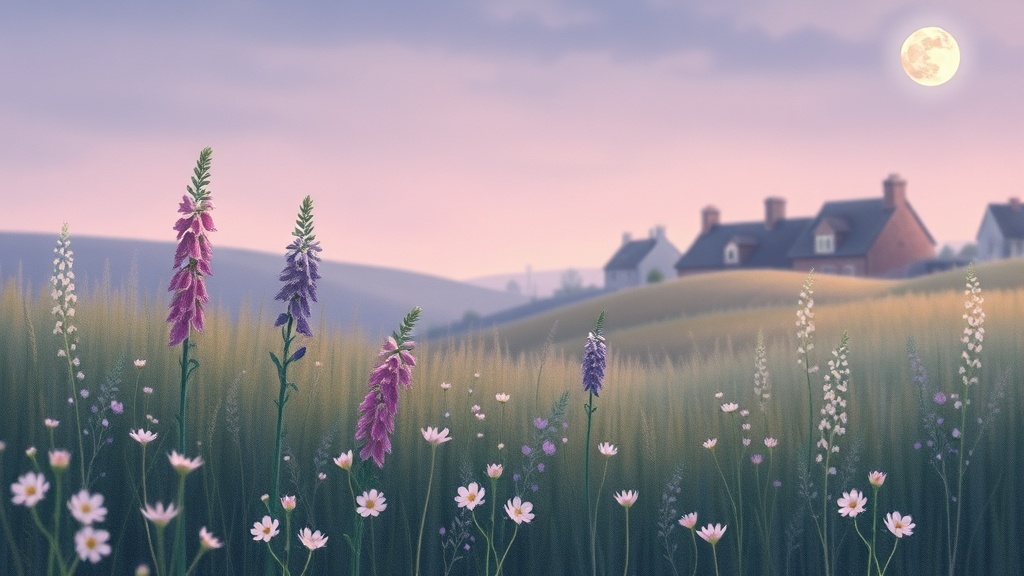
A still wildflower meadow at the edge of a sleeping village in twilight, soft clover and tall foxglove and pale moonbell…

The Dragon Who Said Goodnight

In the meadow at the edge of the village, the flowers hummed.

They hummed low and slow, the way a kettle hums when it forgets it is boiling. Clover and foxglove, moonbell and sweet-fern — all of them breathing music into the warm dark air.

Mira sat in the middle of the meadow with her shoes off and her toes in the grass, listening. She came here every evening when the village went quiet and the lamps winked out one by one.

That is when she heard it — not a hum, but a wingbeat. Soft. Enormous. Like a sail filling with wind.

He landed without a sound.

He was so big that his shadow covered the whole meadow. His scales were the colour of a stormy sea at twilight — deep blue-green and faintly glimmering. But along the edges of his great wings, the scales gave way to something softer. Feathers, pale as milk, that trembled in the breeze like the petals of the moonbell flowers below.

His name was Sorvel.

Mira had never seen Sorvel before. But she was not frightened. There was something about the way he folded his wings, slowly and carefully, so as not to flatten a single flower.

"Hello," she said.

Sorvel tilted his enormous head. One golden eye, large as a cartwheel, looked at her with great gentleness. Then he lowered his neck until his chin rested on the ground, and he waited.

Mira looked at his back. She looked at the feather-edged wings, folded and still. She took one careful step, then another, and climbed up between his shoulder blades, where the scales made a soft, warm hollow just the right size for a small girl.

Sorvel rose.

It did not feel like falling upward, the way Mira had always imagined flying would feel. It felt like being lifted by a careful pair of hands. The meadow shrank below her — a dark circle of softly humming colour. The village rooftops came into view, chimneys still trailing thin ribbons of smoke, every window dark and dreaming.

Up and up, until the air grew cool and bright.

And there was the moon.

She was large and round and the colour of warm cream, and she seemed pleased to have company. Mira felt sure the moon smiled, the way a friend smiles across a room — not a big smile, just a small, certain one.

Mira smiled back.

For a long time, she and Sorvel drifted through the quiet sky. Below them, the village slept. Above them, the stars kept still.

Then, slowly, Sorvel began to glide back down.

He landed in the meadow again, just as softly as before. The flowers were still humming. Mira slid from his back and stood in the grass, her heart full of something she did not have a word for yet.

"Goodbye," she said.

Sorvel looked at her with that golden eye. Then he looked up at the moon. Then he looked back at her, and he blinked — one slow, deliberate blink.

Mira thought about that blink all the way home.

Somehow, she did not think it meant goodbye at all.

What makes Dreamtime dragons stories different

  • Calibrated to your child's age — vocabulary, sentence length and plot complexity pitched to the youngest child in your household.
  • Values woven in, never lectured — pick kindness, courage, patience, honesty; Dreamtime threads one or two gently into each plot.
  • A recurring cast your child grows attached to across nights. Pin a favourite dragon; they come back tomorrow.
  • Always friendly dragons, never scary monsters. Bedtime-safe for ages 2–10.
  • Stories that improve as you rate them — 👍 or 👎 after each one nudges future picks.
  • A fresh story every night. Never the same adventure twice.

Tonight's dragon story is a fresh one — calibrated to your child, woven with the values you picked.

Dragons stories by age

More bedtime story themes

  • Unicorns
  • Wizards
  • Fairies
  • Knights
  • Pirates
  • Space
  • Mermaids
  • Princesses

Frequently asked dragons bedtime story questions

Are dragon bedtime stories scary for young children?

Not in our hands. Dreamtime dragons are always friendly — lost in gardens, learning to fly, carrying children gently home. We never generate scary dragons, monsters, or cliffhangers at bedtime. If a generated story ever feels off, tap regenerate and we tighten the guardrail.

What age are dragon stories best for?

Dragons work beautifully from age 3 upwards. For toddlers (2–3), we'll keep the dragon tiny and gentle. For older kids (6–10), dragons can be majestic and the adventure can stretch further. You pick the age band; we pitch the story accordingly.

How long is a typical dragon bedtime story?

About 5 minutes read-aloud (roughly 400 words) — the sweet spot for holding attention without stretching bedtime. You can also ask for a shorter (2-minute) or longer (10-minute) version.

Can I make the dragon a specific colour or personality?

Yes. You can give the dragon a name, pick a colour (emerald, ruby, silver), and set a tone (friendly, shy, brave). The story will be calibrated around those choices — the dragon is a character, your child is the listener.

Does my child appear as a character in the dragon story?

No — and that's a deliberate choice, not a missing feature. Dreamtime writes stories for your child, not about them. Their name is captured so the app can greet them warmly, but it's never used inside the story. We find kids engage more deeply with characters slightly outside themselves — a brave fox, a shy dragon — than with a name-graft that breaks the moment a detail doesn't fit.

Tonight’s dragons story is 30 seconds away.