Thresh and the Well at the Edge of the Square
A bedtime story shared by a Dreamtime family
24 June 2026
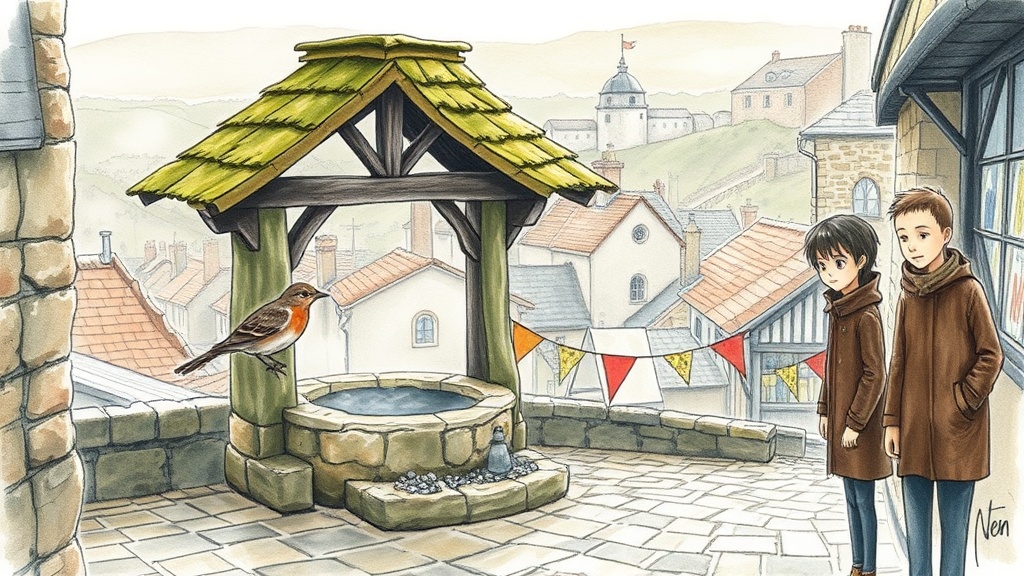
At the top of Callowick Hill, where the wind came in from three directions at once and brought a different rumour from each, there was a well.
Not a new well, not a grand well — just an old one, built from pale limestone blocks that had gone mossy at the joints. Its wooden roof had warped long ago into a gentle lean. Its rope was thick as a thumb and dark with years of wet hands. The iron ring at the top of the windlass was worn smooth in exactly one spot, where thumbs had pressed since before anyone in Callowick could remember.
The well did not speak. But it listened in a way that things made of deep stone and deep water tend to listen — from a long way down.
Every morning, before the market carts arrived and the smell of nutmeg and smoked cheese spread across the square, the well was visited by a sparrow named Thresh.
Thresh was small and grey-brown, with a single white feather at the very tip of her left wing that she could never quite see herself, though everyone else could. She came to the well's rim each morning not for water — she drank from the fountain near the baker's chimney, where the water was warm — but for the listening.
She would sit on the worn iron ring and cock her head, and up from the dark water below would come the faintest sounds: a cart's wheel turning two valleys over, a bell from the shepherd's pass, a name called out in a language she didn't know. These were the whispers the wind dropped down into the well, and the well held them the way a held breath holds something precious.
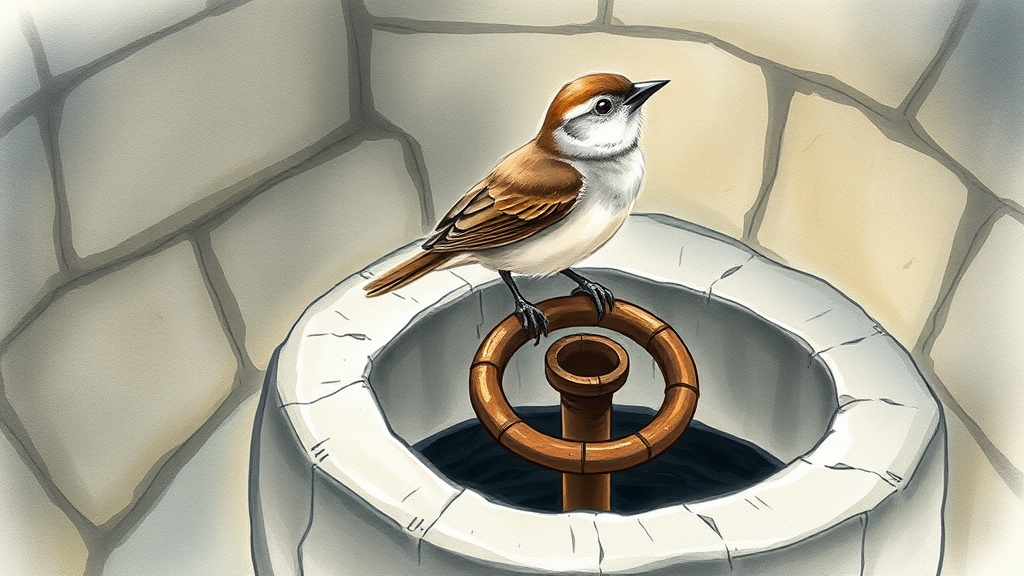
Thresh had been coming here for two seasons. She didn't tell the other sparrows about it. It wasn't a secret exactly. It was more that she wouldn't have known how to explain why she kept returning.
This particular morning, Thresh heard something new.
It was a sound like paper being folded, or like someone trying very hard not to cry. It came from below — from the water — but it also came from behind her, from the square. She turned.
Sitting on the cobblestones near the base of the well, his back against the limestone, was Fenn.
Fenn was a boy of about nine, angular and dark-haired, with ink on the side of his hand from a pen he carried always in his jacket pocket. He was the schoolmaster's helper, which meant he spent most of his day moving quietly between classrooms and not being noticed. He was good at not being noticed. He came to the square sometimes when he needed to think, and he sat near the well because, he had told no one, it felt like sitting next to someone who wasn't going to say anything unhelpful.
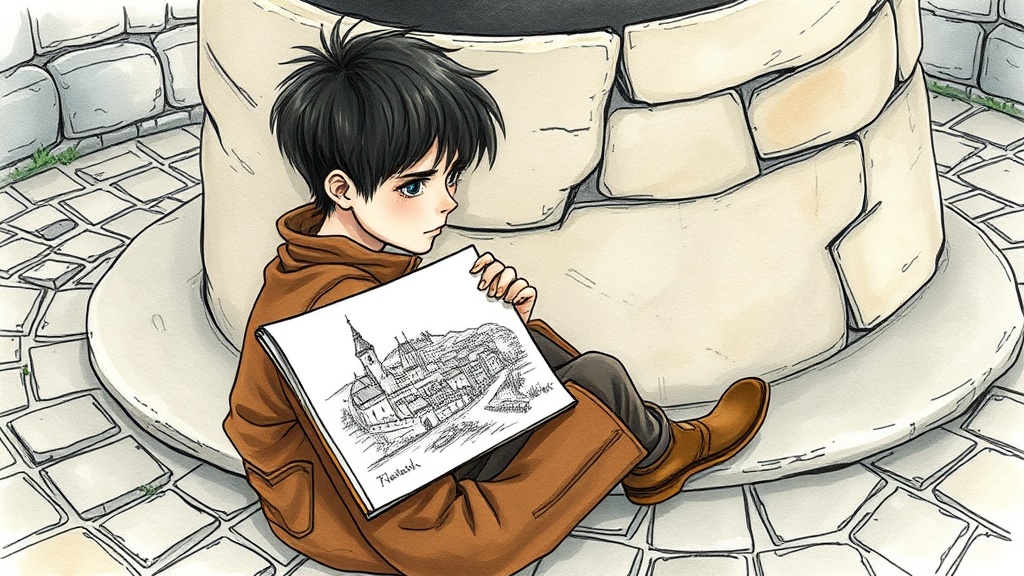
Today he had a piece of paper in his lap. On the paper was a drawing of the hill town — the rooftops, the winding lanes, the well itself — done carefully in brown ink. At the bottom of the drawing, he had written, in his neatest hand: For the notice board. Summer Faire. And then he had stopped.
He had been carrying the drawing for eight days. The notice board was fifteen steps away.
Thresh watched him. She did this without moving, the way old stones sit with the weather.
Fenn looked up. He saw the sparrow on the iron ring. Sparrows sat on the well often enough, so he looked back down.
Thresh looked at the drawing. She looked at the notice board. She looked at Fenn.
Then she did something she had never done in two seasons of morning visits. She flew from the well — from her well, from the cool smooth iron she had worn a little smoother herself — and she landed on the folded edge of the paper in Fenn's lap.
Fenn went very still.
Thresh looked at the drawing. It was a good drawing. The well in it was particularly good: a little lopsided, with the lean of the wooden roof caught exactly right.
She looked at Fenn.
He breathed out slowly.
"It's not very good," he said, to the sparrow, who was certainly not going to argue. But then he stopped, because actually that was not quite what he meant. What he meant was: what if no one wants it. What if I pin it up and someone takes it down.
Thresh walked in a small circle on the paper, which is not what anyone would have chosen for their careful drawing, but Fenn found that he didn't mind. The ink was dry. Her feet were barely the weight of a thought.
When she reached the bottom corner of the page, she stopped, looked once more at the notice board, and flew back to the well.
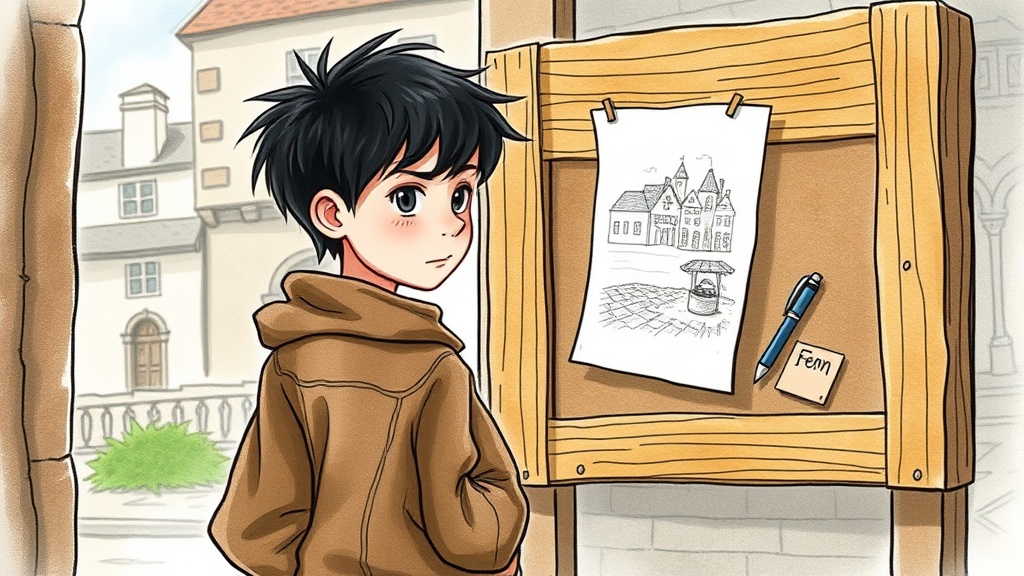
Fenn looked at the tiny smudge her feet had left at the corner of his drawing. Then he looked at the notice board. Then he folded the drawing — once, to protect it from the morning wind — stood up, walked the fifteen steps, and pinned it.
It was not a remarkable walk. The wind came in from the east as he did it, and it carried a scent of pine resin and rain from somewhere far away, the kind of smell that made you think of places you had not been yet.
Fenn stood back and looked at the notice board. His drawing was there now, among the other pinned papers — a lost-cat notice, an announcement about the harvest water barrel, a yellowed scrap that had been there so long no one remembered what it said.
He didn't feel triumphant. He felt something smaller and truer than that — like a held breath, released.
He walked back past the well. Without stopping, without looking up, he ran his thumb along the worn smooth spot on the iron ring.
On the rim above him, Thresh settled her feathers, tucked her left wing in until the white tip disappeared, and turned her ear back down toward the water, where the wind was still dropping its soft freight of distant sound into the dark.
The square filled up slowly around them. The nutmeg smell arrived. The first cart wheel found the stones. And far below, in the cold water where the whispers gathered, the morning went on collecting itself, as it always did, ready for the next time someone needed to sit beside it and not be told a single thing.
Give your child a new story every night
Dreamtime writes a brand-new illustrated bedtime story every night, calibrated to your child's age, with themes you pick and values woven in, never lectured.
Start your free trial →