Old Thistlewood and the Missing Tide
A bedtime story shared by a Dreamtime family
10 August 2026
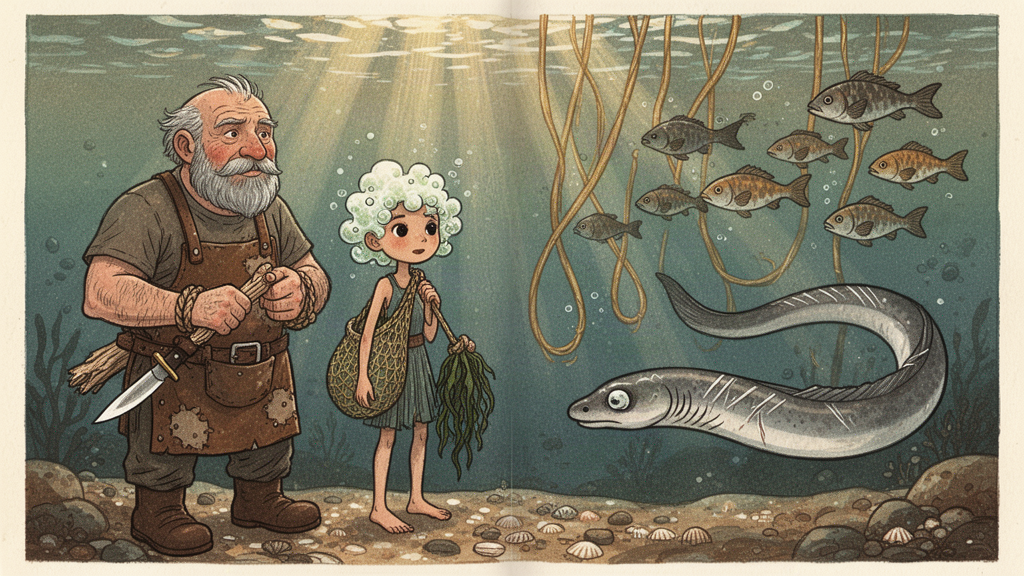
Down at the bottom of the sunlit sea, where the light came through the water in wavering gold ropes, there was a village built inside the ribs of a whale so old that barnacles had grown over its name. The houses were fitted between its bones like drawers in a cabinet, and the streets were paved with flat white shells that clicked underfoot. Everyone in the village of Hallowdeep knew Old Thistlewood, the whittler, because everyone in Hallowdeep owned at least one of his driftwood animals — a seal on a windowsill, a heron by a door, a small blunt-nosed whale set on a shelf to watch over supper.
Thistlewood was a broad old man with hands like knotted rope, and he did not talk much while he worked. He sat outside his door every morning with a piece of driftwood between his knees, turning it slowly, looking for the animal already hiding inside the grain before he ever picked up his knife. His granddaughter had never existed and never would, in this telling, but he had something better for company most days: a girl named Pell, who fetched his driftwood from the tideline caves and never once, in three years, asked to be paid.
Pell was thin and quick, with hair the greenish-white of sea foam, and she talked enough for two people. On the morning the tide went missing, she came skidding into Thistlewood's yard with her collecting sack empty and her face pinched with worry.
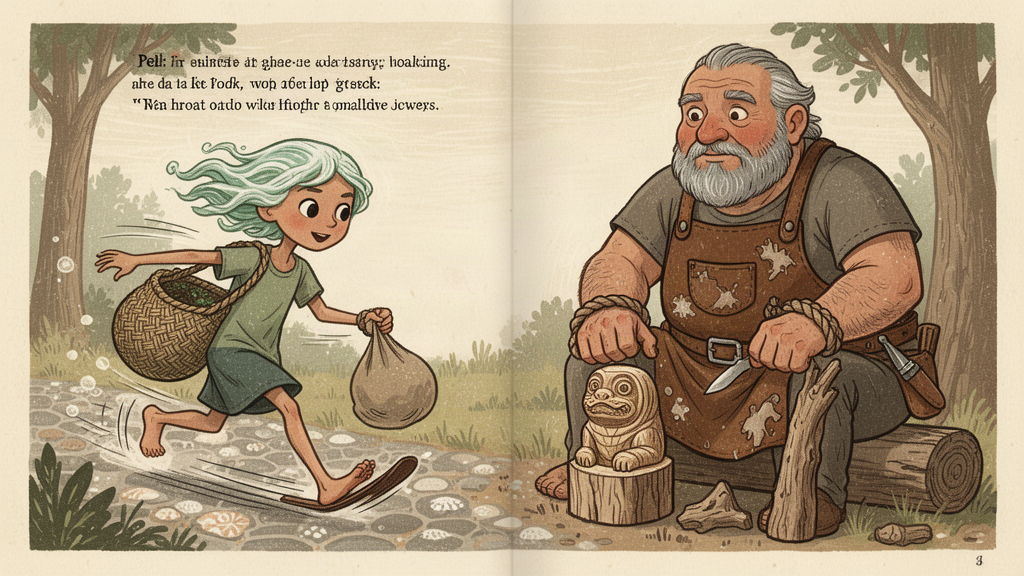
"The Slow Current's stopped," she said. "It's not moving at all. Old Buorin at the mussel farm says his whole crop's going to spoil without the water turning over, and nobody knows why, and everybody's asking everybody else, and nobody has an answer."
Thistlewood set down the seal he was carving — it already had two flippers and was waiting on its face — and looked at her properly. "The Current doesn't stop," he said. "Not since before I was your age."
"Well, it has now."
They went together to see it, out past the last house, where the water usually moved in a long unhurried river-within-the-sea, carrying silt and warmth and small drifting fish down toward the deep meadow. It was still. Fish hung in it confused, turning in slow circles like they'd lost their sentence halfway through.
"Everyone's saying it's the Current-keeper," Pell said. "That she's angry. Or asleep. Or gone."
"Everyone's always saying something," Thistlewood said, but he said it without unkindness, the way you'd note that the sky was a particular color.
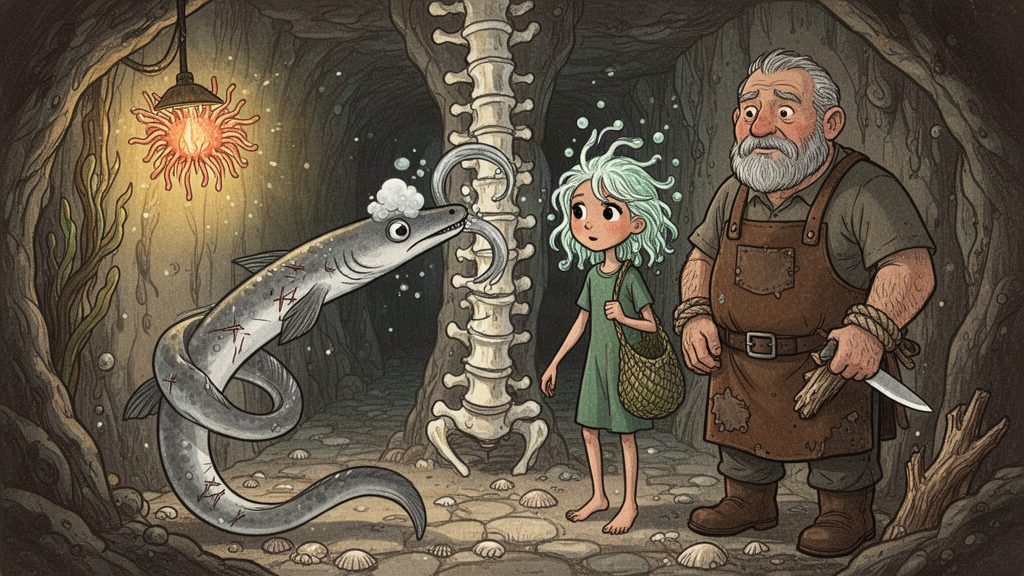
The Current-keeper was a story more than a certainty — an eel-shaped woman, some said, who lived in the throat of the old whale-village's spine and kept the water moving the way a heart keeps blood moving, mostly forgotten about until something went wrong. Pell wanted very badly to go and find her. Thistlewood was not sure there was anything to find.
"If it's a fright, you don't fix a fright with cleverness," he said, mostly to himself, running his thumb along a groove in the driftwood in his pocket — he always kept a piece there, unfinished, in case his hands wanted something to do while his mind worked elsewhere. "You fix it the slow way."
They went down into the whale's spine together, Pell in front with a glowing anemone-lamp, Thistlewood behind with his knife still in his belt because it was the only tool he trusted. The passage narrowed. The bones here were old and yellow and the water tasted of iron.
They found her curled at the very last vertebra, where the spine pinched down to nothing. She was smaller than the stories made her — a silver-grey eel no longer than Thistlewood's arm, with old scars along her side and one clouded eye. She flinched hard from the lamp.
"Don't," she said, in a voice like water pulled over gravel. "Don't come closer. I can't move it. I can't move the Current. My side's torn on something down here and it won't heal and I can't keep the water going and now everyone up there will know I've failed and they'll come with hooks —"
"Nobody's bringing hooks," Pell said, too quickly, the way she said most things.
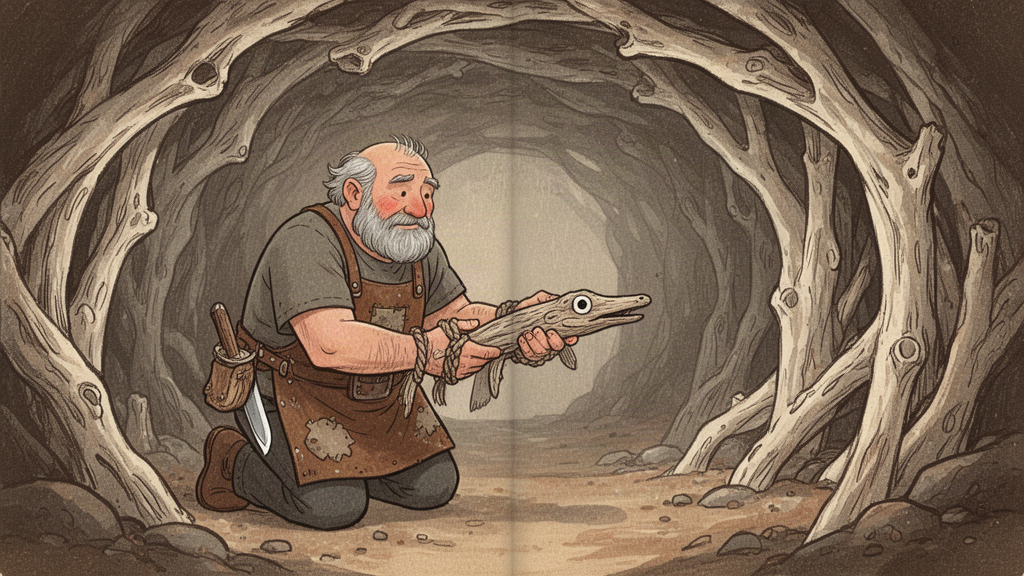
Thistlewood didn't say anything at all for a while. He crouched, slow, the way you'd crouch near a nervous dog, and he took the unfinished driftwood from his pocket and kept turning it in his hands, not looking straight at her.
"I've got salt-moss at home," he said finally. "Good for tears in skin. Slow to work. Doesn't ask anything of you while it works, either." He glanced at the eel's side, not staring, just noting it the way he noted grain in wood. "I'll bring it. You don't have to hold the Current while I'm gone. Let it sit still a day. Fish don't mind a still day."
The Current-keeper's clouded eye watched him with something that wasn't quite trust yet. "You're not afraid of me," she said, as if it were an accusation.
"I'm seventy-one," Thistlewood said. "I've been afraid of plenty. Ran out of room for you today."
Pell went back up alone, fast, her lamp bobbing, and told Buorin and the others only that the Current would move again soon, and that nobody needed to bring anything sharp down into the spine, not now, not ever, and she said it with such flat certainty that even the ones who liked to argue didn't.
It took six days. Thistlewood went down each morning with fresh moss and said little, and the eel — whose name, it turned out, was Ilsevine — talked more each visit, mostly complaints about the cold and the dark and, eventually, about a keeper before her who'd drowned trying to hold the Current alone during a bad year, and how she'd promised herself she'd never ask anyone for help the way that keeper hadn't been able to.
On the seventh day the Slow Current moved again, gently, and the fish that had been hanging confused in it began, one by one, to remember which way was down-current and swam off looking faintly embarrassed.
Pell met Thistlewood coming up out of the spine, his knees stiff, his hands smelling of salt-moss. "Did you fix her?" she asked.
"Didn't fix anything," Thistlewood said. "Just kept showing up." He held out the driftwood piece from his pocket, finally finished — a small eel, silver-grained, with one eye left rough and unpolished on purpose. "Give her this. Tell her the rough eye's not a mistake. Tell her I left it that way on account of it suited her."
Pell turned the little carving over in her hands, felt the one smooth eye and the one deliberately unfinished, and went back down into the whale's old bones to deliver it, already rehearsing exactly how she'd say it.
Give your child a new story every night
Dreamtime writes a brand-new illustrated bedtime story every night, calibrated to your child's age, with themes you pick and values woven in, never lectured.
Start your free trial →