Millie and the Kite Called Loop
A bedtime story shared by a Dreamtime family
3 August 2026
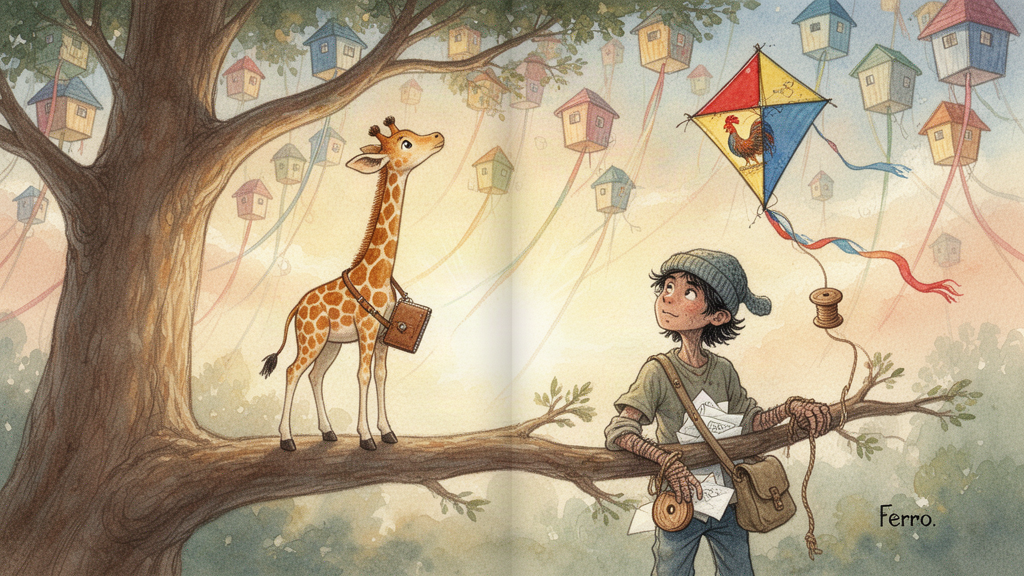
In the city of Windhome, every house was a kite, and every kite was tied by a long ribbon-string down to the branches of one enormous tree that grew taller than any tower and wider than any square. The kite-houses bobbed and dipped in the wind, tugging gently at their strings like dogs on a leash, and if you stood at the very bottom, at the roots, and looked up, you saw hundreds of bright paper roofs turning slowly against the sky.
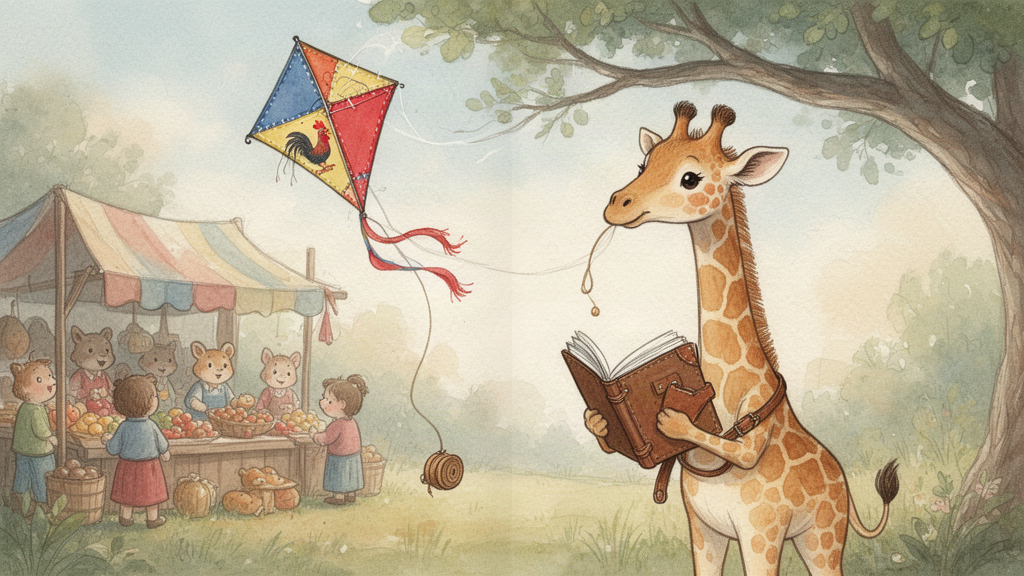
Millie the giraffe lived near the roots, in a wooden room tucked between two of the tree's biggest branches, because giraffes were too tall and too heavy to live properly in a kite-house without tipping it sideways. She didn't mind. She had a notebook, soft-cornered from carrying, and in it she kept a list of small things. Not big things — not mountains or storms — but small things, the kind most people walked straight past. Today's list, so far, said: a beetle the color of a plum, a step that creaked in two different notes, and dew caught in a spiderweb like tiny lanterns.
It was on the middle branch, the wide flat one where the tree-market sold string-cakes and sky-berries, that she met the kite called Loop. He wasn't a house-kite — he was a messenger-kite, small and diamond-shaped, patched all over in mismatched paper, red over blue over a scrap of yellow with a picture of a rooster on it. His string was tied to a spool worn smooth by a boy named Ferro, who ran messages up and down the tree for anyone who needed a letter carried faster than legs could climb.
"You're staring at me the way people stare at soup they're not sure they ordered," said Loop, tilting in the wind so his patched corner flapped like a wave.
"I was counting your patches," Millie said. "Fourteen. That's a good number for a list."
"A list of what?"
"Small things I don't want to forget." She showed him the notebook, and Loop, who could not read from a distance because kites are notoriously nearsighted, asked her to read it aloud, and she did, and he laughed at the plum-colored beetle and grew quiet and thoughtful at the dew-lanterns.
"I've never had anything written about me," he said. "Patches, maybe. Not words."
"You're on today's list now. Fourteen patches, likes riddles, doesn't fly straight in a north wind." She had noticed that last part — how Loop wobbled and tugged whenever the wind came from the mountains, as if something up there frightened him a little, though he never said what.
From then on, every day that Millie came to the middle branch, Loop was there, tethered near the string-cake stall while Ferro delivered his letters, and the two of them kept each other company in the unhurried way of old friends, even though they'd only just met. Millie added to her list. Loop supplied half the material — a snail crossing the branch so slowly it seemed to be thinking very hard, a puddle that had frozen into the shape of a leaf, the particular blue of the sky exactly one hour before sunset.
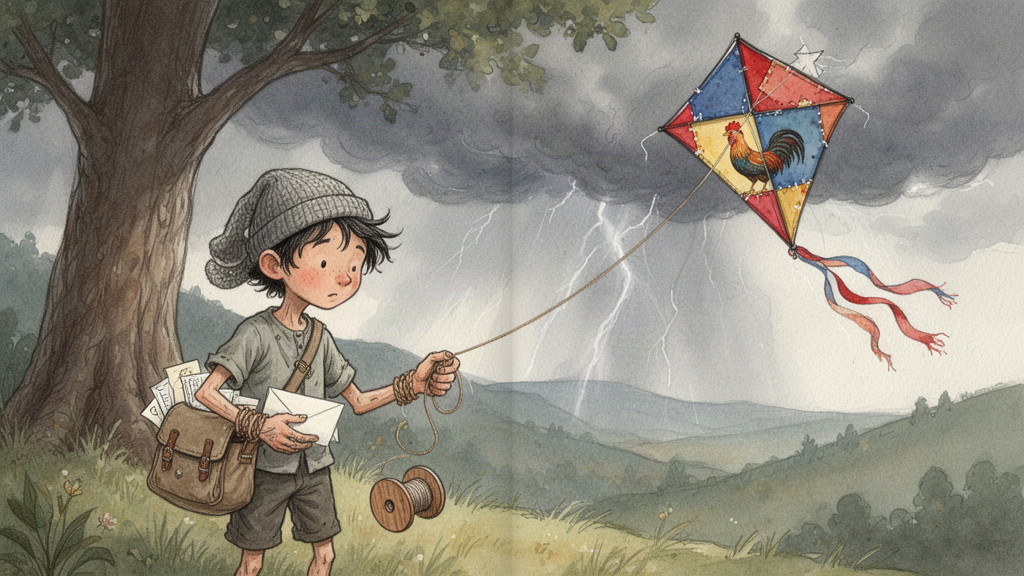
But kites are built to fly, and Ferro's work was growing. A storm was gathering somewhere over the western ridges, and messages needed carrying before the wind turned wild — warnings to the outer kite-houses to batten their paper walls, invitations withdrawn, deliveries hurried along. Ferro told Loop, gently but plainly, the way you tell a friend hard news without softening it into something false: "Tomorrow we fly out past the last branch, all the way to the ridge-houses, and I don't know how long we'll be. Might be a day. Might be longer, if the storm's a slow one."
Loop didn't wobble this time. He went very still, the way paper goes still right before it tears. "Past the last branch," he said. "I've never gone that far."
Millie felt something drop in her, quick and cold, like a stone down a well. She understood, the way you understand a math problem you don't like the answer to, that Loop was leaving, and that leaving might not have a return date stitched to it, the way Ferro's own words had trailed off into "might be longer."
That night she sat on the middle branch long after the string-cake stall had shuttered, her notebook open on her knees, and she wrote nothing. She had never once, in all her list-keeping, not known what to write.
In the morning she found Loop already straining at his spool, restless with the storm-wind rising, patches snapping. Ferro was checking his satchel of letters, humming tunelessly to calm his own nerves.
"I don't want to just watch you go," Millie said, and surprised herself, because she had planned to say something smaller and safer. "I want to give you something to carry. Not a message. A thing to hold onto, past the last branch, if the wind gets frightening."
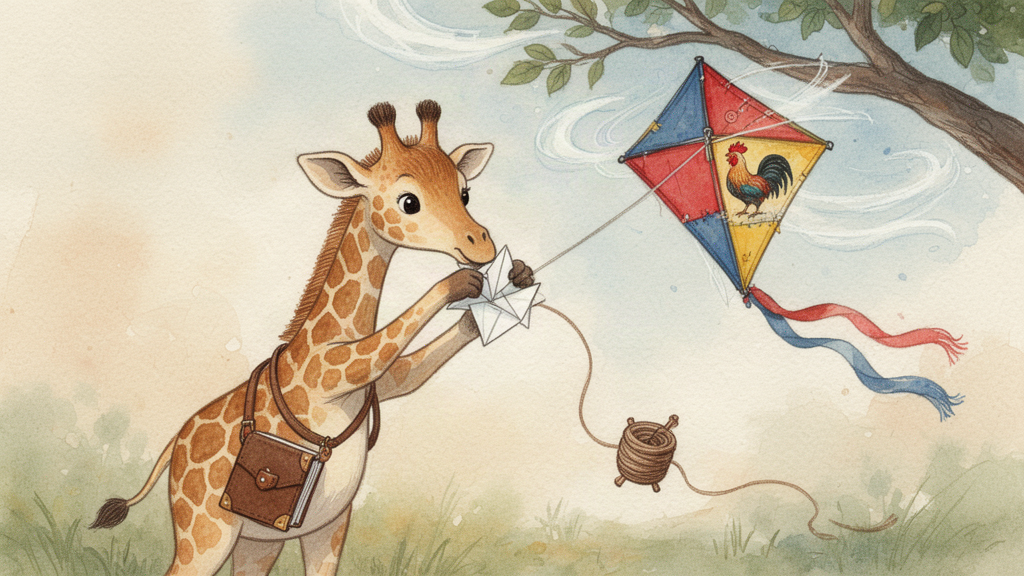
She tore the newest page from her notebook — today's list, still half-finished — and folded it small, the way you fold a paper boat, and tucked it into the gap between Loop's blue patch and his yellow rooster patch, where the wind wouldn't snatch it.
"What does it say?" Loop asked.
"A giraffe who counts patches. A boy who hums when he's scared. A kite who doesn't fly straight in a north wind, and goes anyway." She looked at him steadily. "It's not goodbye things. It's see-you-tomorrow things. You only write those down if you mean to check on them later."
Loop went quiet again, but it was a different quiet than the night before — not stillness like tearing paper, but stillness like listening. "Tomorrow, then," he said, testing the word. "Or the day after. However long the slow storms take."
"I'll keep a list of the days," Millie said. "So neither of us loses count."
Ferro whistled the launch-note, and the spool spun, and Loop rose past the middle branch, past the upper houses, patches snapping like small brave flags, out toward the last branch and the grey ridge beyond it, carrying a folded page no bigger than a leaf.
Millie stood watching until he was a red-blue speck against the clouds, and then she opened her notebook to a fresh page and wrote, at the very top, Day One. Underneath, she began the list again — a beetle, a creaking step, a patch of sky the color it turned exactly one hour before the wind brought someone home.
Give your child a new story every night
Dreamtime writes a brand-new illustrated bedtime story every night, calibrated to your child's age, with themes you pick and values woven in, never lectured.
Start your free trial →