Gorm and the Boot Beneath the Bridge
A bedtime story shared by a Dreamtime family
3 July 2026
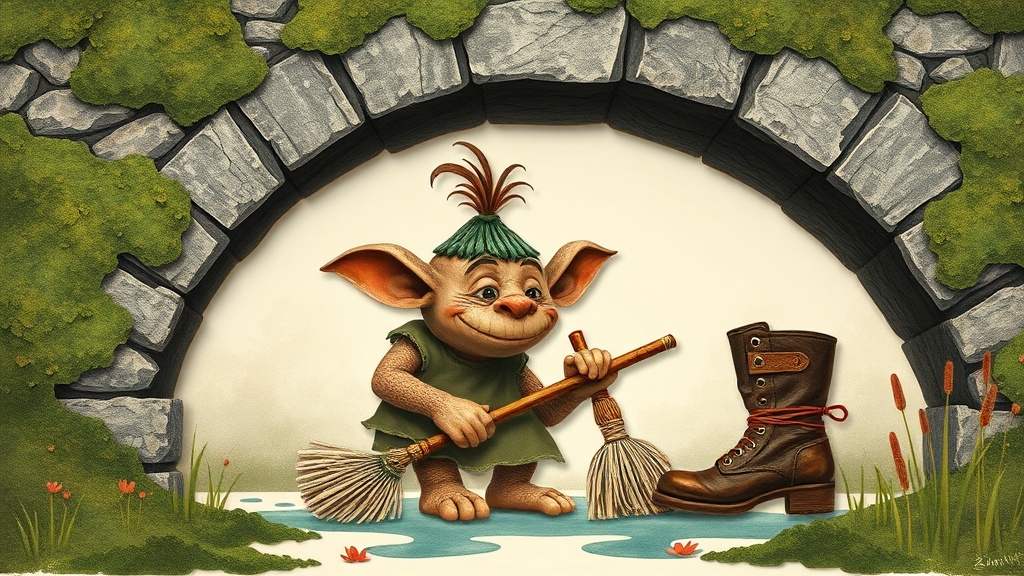
Under the old stone bridge at the edge of Whistling Fen, there lived a troll named Gorm.
He was not a large troll. He was not a frightening troll. He was, if anything, the sort of troll who apologised to beetles when he accidentally stepped near them. His hands were the colour of river mud, his ears were wide as dock leaves, and he had a single mossy eyebrow that ran all the way from one side of his face to the other like a friendly caterpillar. He kept his bridge very tidy. He swept the underside every morning. He liked the quiet.
What Gorm wanted — and had wanted for quite some time — was to hear the Upward Rain.
Every Tuesday in Whistling Fen, without fail, the rain fell the wrong way. It started at the ground and climbed, droplet by droplet, straight up into the sky. The puddles would thin and vanish. The mud would tremble. And then — according to everyone in the village — it made the most extraordinary sound. A rising, silver hiss that turned, at the very top, into something like a note held by a very far-off bell. People pressed their faces to their upstairs windows just to hear it.
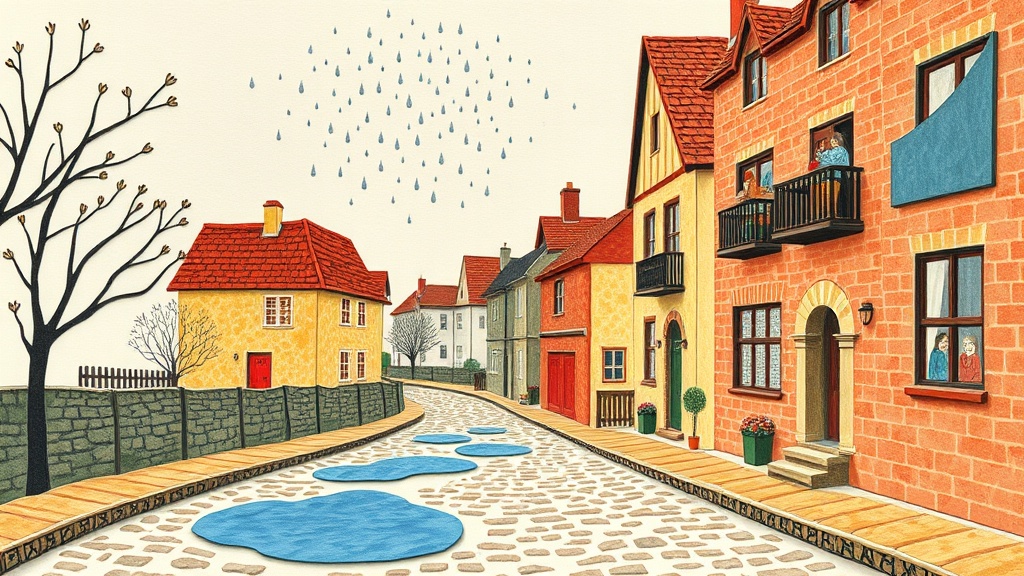
Gorm had never heard it. He lived under the bridge, and under the bridge, the sound of upward rain was swallowed by the stones.
He had tried, once, stepping out just past the bridge's edge on a Tuesday. But the upward droplets had gone straight into both his ears, and he had sneezed so hard that he sat down in the ditch and missed the sound entirely.
That was when he found Sorrel.
The boot was already there, tucked against the ditch grass, exactly as Gorm remembered from the last time their paths had crossed — dark chestnut leather, copper eyelets catching what little light there was, the faded red thread at the ankle looking perhaps a fraction less frayed than before. Sorrel said nothing at first. Sorrel often said nothing at first. But those boot-eyes — the creased notches in the leather above the toe — were already scanning the underside of the bridge with quiet interest.
"You noticed something," said Gorm. It was not a question.
"The acoustics," said Sorrel, after a moment. "The arch bounces the sound down before it can get up. Like a cup held upside down." The boot paused. "I noticed it the last time I was here. Took me a while to be sure."
That was Sorrel all over. Noticing first, saying second, acting third — but usually right.
"Then you know what to do?" said Gorm hopefully.
"I have an idea," said Sorrel. "I'm not rushing."
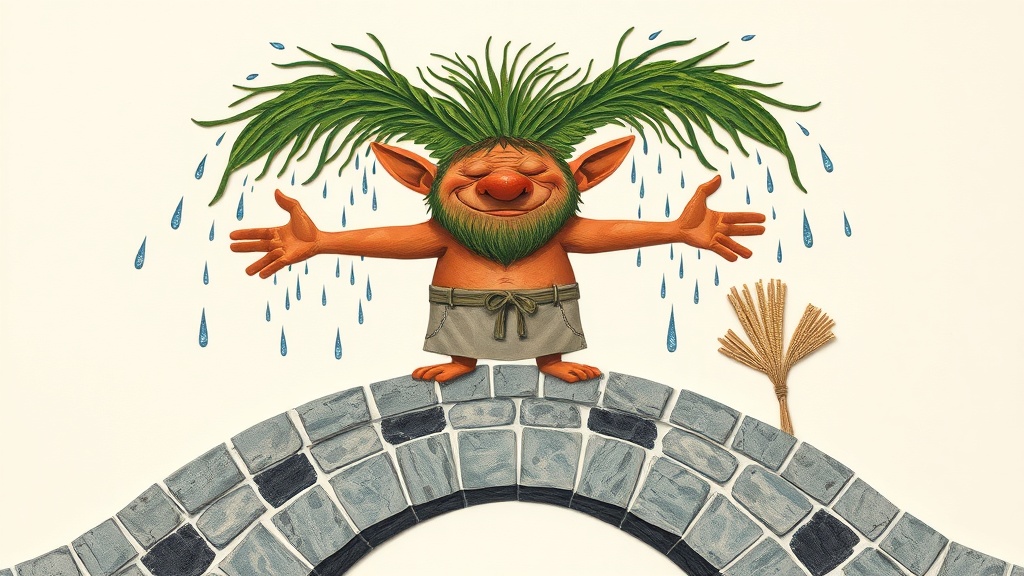
The first idea was Gorm's. He was very proud of it. He would climb to the top of the bridge on Tuesday morning and stand up there in the open air, as high as possible. Up there, he reasoned, the sound would reach him before the stones could swallow it.
Tuesday came. The puddles began to tremble. Gorm hauled himself, with considerable effort, to the very crown of the bridge's arch, and stood with his dock-leaf ears spread wide.
The upward rain arrived.
It also arrived, very directly, into Gorm's mossy eyebrow, which absorbed it like a sponge. The eyebrow swelled. Water dripped down over both eyes. Gorm stood there, completely blind, hearing absolutely nothing but the dripping. By the time he wiped his face clear, the rain had finished.
He sat on the bridge for a while, eyebrow dripping.
Sorrel, who had watched from the ditch, did not say anything. Sorrel knew better than to say anything.
The second idea was a joint effort. If the sound went upward and the bridge caught it, then what was needed, Sorrel reasoned aloud, was something funnel-shaped — something to catch the sound above the bridge and direct it down to Gorm's ears. They spent Monday evening constructing a funnel from a curled piece of bark and some hollow river reeds.
Tuesday came again. Gorm held the funnel above his head with both arms stretched high. The puddles thinned. The upward rain began.
The funnel, as it turned out, was excellent at catching upward rain. It collected a remarkable quantity of water and deposited all of it, at once, down the hollow reeds directly into Gorm's left ear.
He sat in the ditch for a very long time, tilting his head.
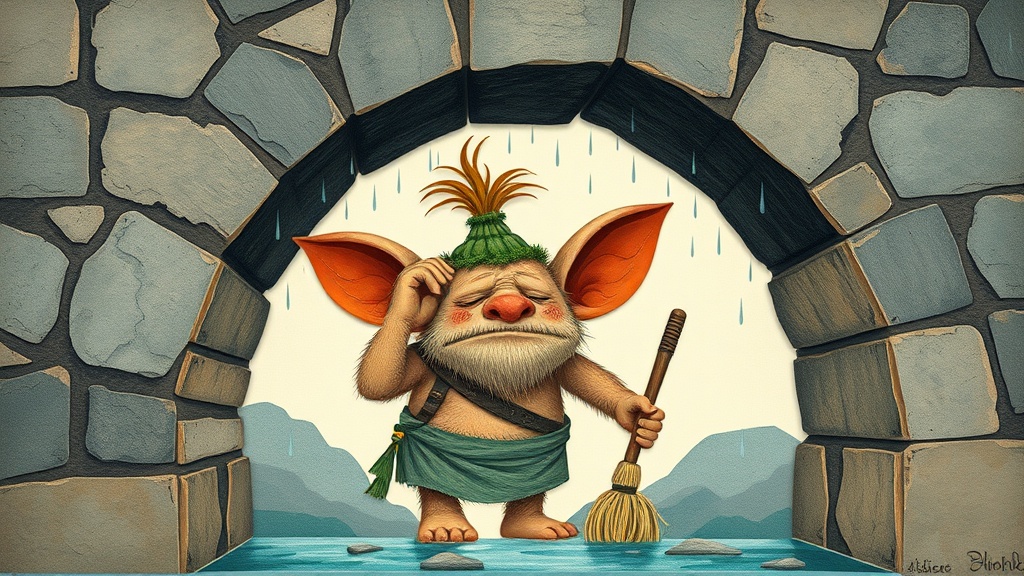
It was Sorrel who finally spoke. Not with a solution — just a question.
"Where do you hear things best?"
Gorm considered. "Under the bridge," he said, a little miserably. "Obviously. When it's quiet."
"Yes," said Sorrel. And then the boot was quiet for a long time, looking at the arch of the bridge from the outside. Looking at the way it curved. Looking at something Gorm couldn't quite see yet.
"Gorm," said Sorrel, slowly, "when you put a shell to your ear, where is the sound?"
"Inside it," said Gorm.
"Right," said Sorrel. And then, carefully: "What if you don't go up to the sound. What if you let the bridge be the shell."
Gorm opened his mouth. Closed it.
He went under the bridge. He pressed one wide, dock-leaf ear flat against the keystone — the very centre of the arch, the highest point from underneath. He had swept that stone a hundred times. He had never listened to it.
Tuesday came for the third time. The ground trembled in its small, familiar way. The puddles lifted and disappeared, drop by drop, into the air above the village of Whistling Fen.
Gorm pressed his ear to the stone.
The sound came through it.
Not the silver hiss — not exactly — but something that the stone had been keeping, a low, travelling hum, as though the rain's climbing note had been caught in the arch all along and had simply been waiting for someone to put an ear to the right place. It was not quite what anyone else heard. It was the bridge's own version. Stone-coloured and deep and very, very still at the edges, the way the last of a sound is.
Gorm stayed like that until it was finished.
After a while, he heard Sorrel's familiar creak-and-tap crossing the bridge above him. The boot appeared at the ditch bank, copper eyelets glinting.
"Well?" said Sorrel.
Gorm thought about it. He swept his hand across the cool stone of the arch, very slowly, the way he did every morning — but softer this time, the way you touch something you've only just understood.
"Different," he said. "From up there, I think."
"Probably," said Sorrel.
"But it was mine," said Gorm.
Sorrel said nothing. But when the boot turned to go, there was something in the way it moved — a fraction less hesitation before the first step — that was perhaps new, and perhaps not.
Give your child a new story every night
Dreamtime writes a brand-new illustrated bedtime story every night, calibrated to your child's age, with themes you pick and values woven in, never lectured.
Start your free trial →