Fenn and the Storm That Wasn't the End
A bedtime story shared by a Dreamtime family
10 July 2026
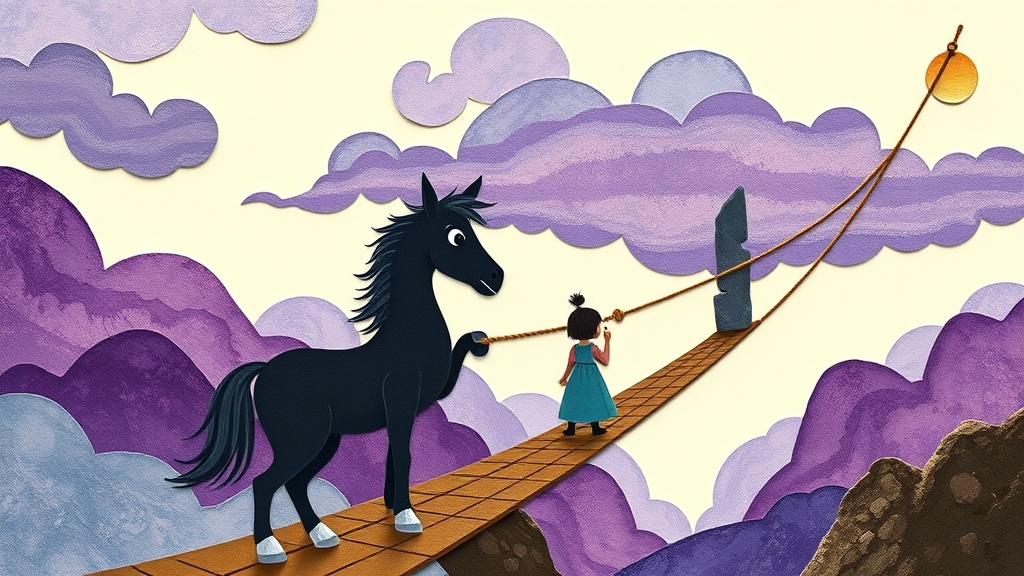
The rope bridge was already swaying when Fenn dug all four paws into the turf and refused to move another step.
Below the bridge — far, far below — there was nothing. That was the thing about living on a floating island: the edges were real, and the drop was real, and the thunder Fenn had been watching build all morning was now close enough to feel in his teeth. The sky beneath the island had turned the colour of a bruise.
Wren was already halfway across the bridge. She had stopped when Fenn stopped, because that was the sort of thing Wren did — she noticed when something changed, even something behind her.
"You've been watching it since breakfast," she said. Not an accusation. Just a fact she had collected.
"Since before breakfast," Fenn muttered. "Since the first cloud came up through the Underneath."
He was a small kelpie, dark as river mud after rain, with a mane that stuck up in five directions no matter how he flattened it. His hooves were silver-pale and left faint frost-prints on the grass, even in summer. He was not built for bridges. He was not built for edges. He had always known that about himself, the same way he knew his own name.
The bridge led to the Spindle — a narrow tower of rock that jutted up from the far side of the island like a crooked finger. At the top of the Spindle was the storm-bell, and the storm-bell was the only thing that could warn the island's lower terraces in time. Without it, the fisher-folk and the market stalls and old Bramwick's orchard would have no warning at all before the storm hit.
Fenn had been chosen to ring it. He was fast, everyone said. Fastest on the island. Which was true, and wonderful, right up until the moment he had to cross a swaying rope bridge above an endless drop with a purple-black storm climbing toward him.
Wren took a few steps back toward him. She set her glass jar down on the planks — it caught a distant flash of lightning and threw a small coin of light across her face — and she sat cross-legged, right there on the bridge, like it was a perfectly reasonable place to sit.
"What does it look like?" she asked. "The storm. When you watch it."
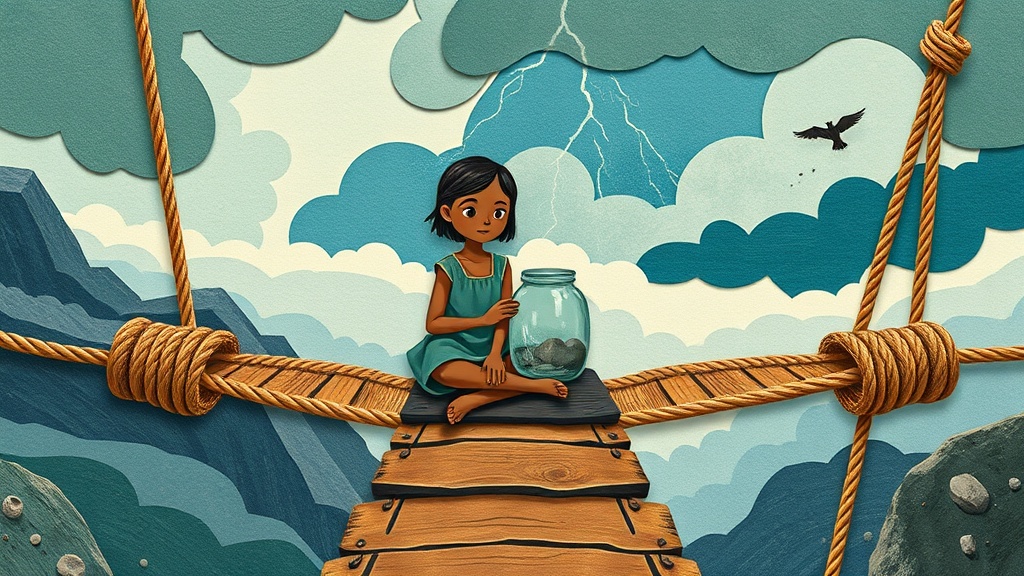
Fenn blinked. Nobody had ever asked him that before. They always just said ring the bell or hurry up or you're the fast one, Fenn.
"It looks," he said slowly, "like something that wants to swallow the island whole."
Wren looked out at the rolling dark. She was quiet for a long moment, in the way she was always quiet — not empty, but full.
"Hm," she said. "I think it looks like it's in a hurry. Like it just wants to get past."
Fenn looked again.
He had been so certain it was aimed at them, at him, at the island specifically. But now he saw what Wren meant: the clouds were moving. They were not gathering around the island to swallow it. They were rolling through, pushing west, already beginning to clear in the east where a thin strip of amber light was pressing up through the dark.
The storm was not stopping. The storm was passing.
It was still enormous. It was still real. The thunder was still loud enough to shake the bridge's ropes. But it was not the end of everything. It was just weather, moving through.
Fenn's hooves unfroze, one at a time.
He took a step. Then another. The bridge rocked and he hated it, every plank of it, but he kept his eyes on the Spindle rather than the drop, and his hooves kept moving because there was something he needed to do.
Halfway across, the wind hit. It came up from the Underneath — cold and spinning — and the bridge lurched sideways. Fenn grabbed the rope rail with his teeth and held on. Wren grabbed the other rail with both hands, her knuckles pale against the rope, her jar tucked tight under her arm.
"Still going?" she called.
"Still going," he said, through his teeth.
The last third of the bridge was the worst. The planks here were older, grayer, and they flexed when he stepped on them in a way that suggested they were thinking about something Fenn didn't want them to think about. He went quickly — not running, because running would be foolish, but moving the way only a kelpie can move, each hoof placed with a kind of swift precision that looked almost like not-touching-the-ground.
He reached the Spindle rock.
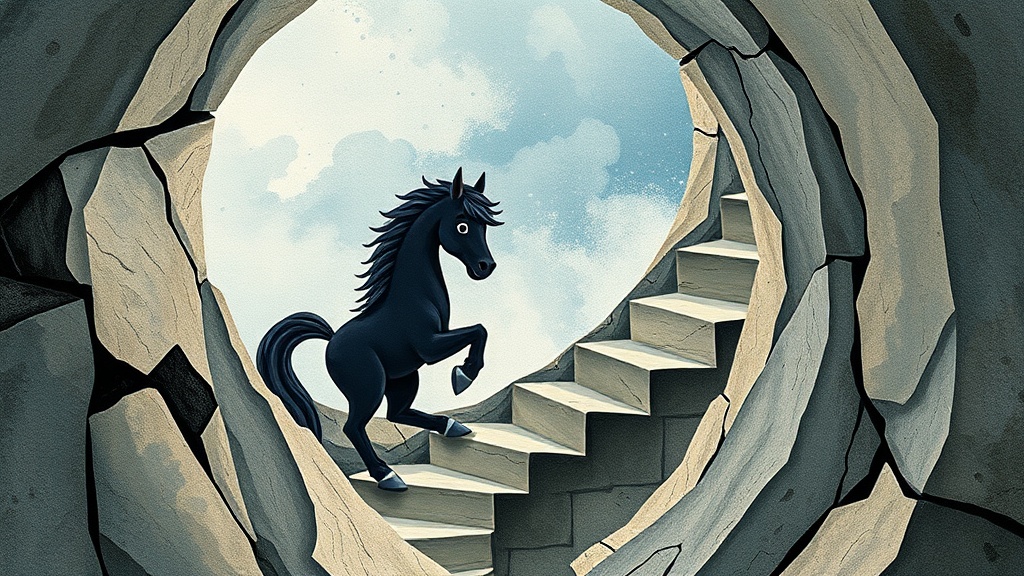
The bell-rope hung at the top of a tight spiral staircase carved into the stone. Fenn was not made for stairs either — too narrow, and his hooves clicked and slipped — but he went up anyway, scraping his shoulder on the curve, tucking his mane against the low ceiling, arriving at the top breathless and wild-eyed and utterly himself.
He rang the bell three times: the pattern for weather warning. The sound was enormous up here, right inside it, like being in the throat of something singing.
Below, on the lower terraces, he saw the tiny figures of fisher-folk pulling their boats under the ledges. He saw the market stalls folding their canvases. He saw, very small, the blue-green smudge of old Bramwick's orchard covering itself in netting.
They heard. They were ready.
Fenn stood at the top of the Spindle and watched the storm arrive and then, slowly, move past — just as Wren had said it would. Rain came in a great slanted curtain and soaked him to the skin. Lightning cracked twice, far to the south. Then the amber strip in the east grew wider, and wider, and the clouds thinned and the Underneath below the island turned silver instead of purple.
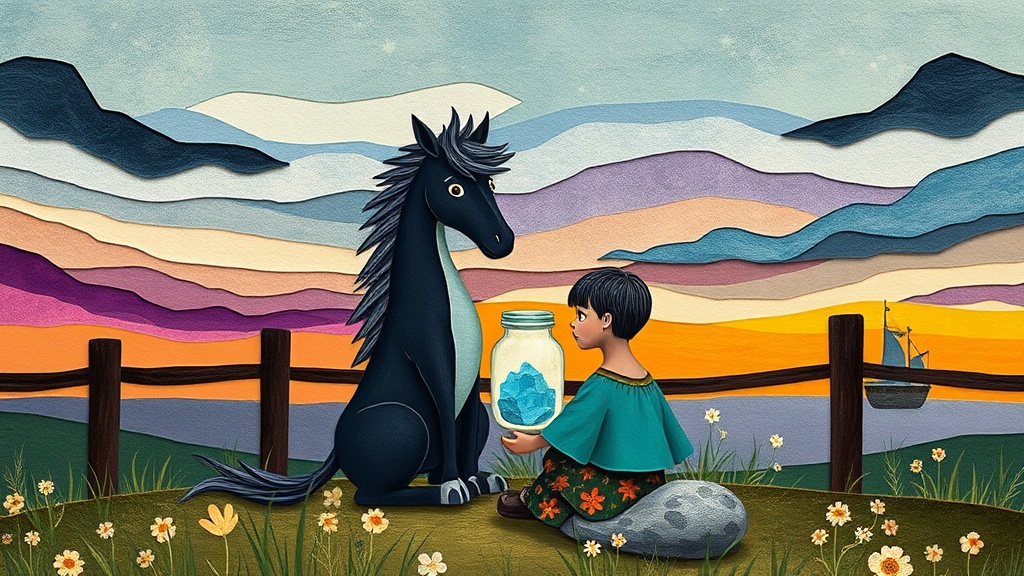
When he came back down the stairs and out onto the bridge, Wren was sitting on the island side of it, back against a fence post, her jar in her lap. Inside the jar, Fenn noticed for the first time, there was something small and luminous — a piece of sky-coral she must have found on one of the island's upper terraces, glowing faintly even in the grey afternoon.
She had added it since the last time he'd seen her. She had been collecting something new.
She looked up at him, and something in her expression was — not surprise, exactly. More like a kind of quiet satisfaction that she kept mostly to herself.
"Bramwick's orchard?" she asked.
"Safe," he said.
Wren nodded and turned back to the sky, the jar resting in the crook of her arm, the sky-coral sending its small light up through the glass.
Fenn sat beside her — carefully, because he was still not certain about the edge — and watched the last of the storm move off to the west, taking its darkness with it and leaving behind an island that smelled of rain and grass and something almost like the sea.
Give your child a new story every night
Dreamtime writes a brand-new illustrated bedtime story every night, calibrated to your child's age, with themes you pick and values woven in, never lectured.
Start your free trial →