Personalised Bedtime Stories With Illustrations: Why They Work So Well
Dreamtime
21 April 2026
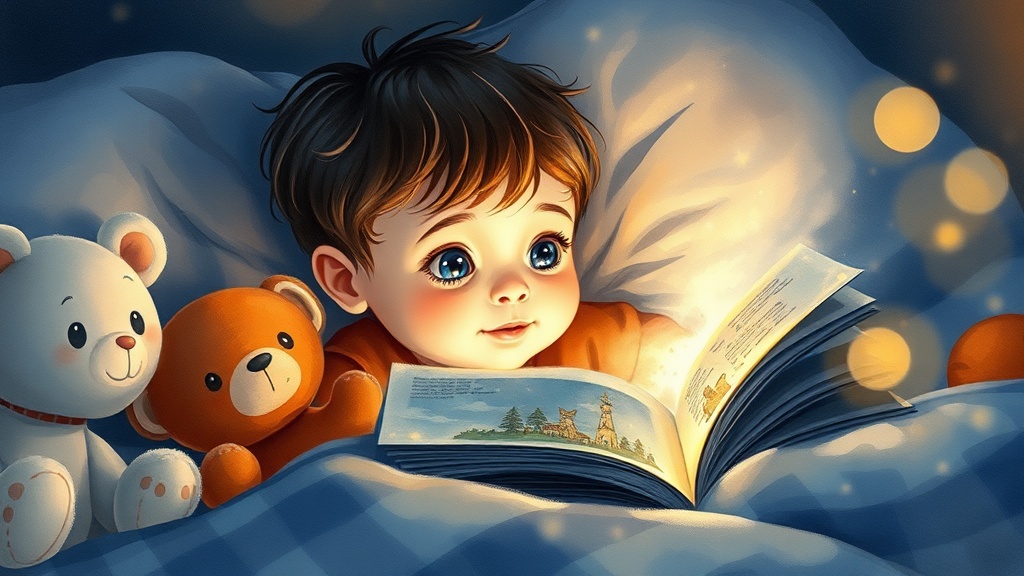
A personalised bedtime story with illustrations does more than entertain — it captures your child's attention, supports early literacy, and makes bedtime feel genuinely magical. Here's what the research tells us, and how to make the most of illustrated storytelling at home.
There's a particular kind of quiet that settles over a child when a story is just right. They stop wriggling. Their breathing slows. Their eyes, fixed on the pictures, go a little wide. If you've ever experienced that moment, you already know intuitively what researchers have spent years confirming: a personalised bedtime story with illustrations hits differently to an ordinary one. It isn't just the pictures, and it isn't just the child's name dropped into the text. It's the combination — story, image, and personal meaning — working together in a way that holds children spellbound and, quietly, does a great deal of good.
Why Illustrations Matter More Than We Realise
For young children, pictures aren't decoration — they're half the story. Children aged two to seven are still developing the cognitive tools needed to build mental images from words alone. Illustrations do that work for them, freeing up their attention to focus on language, plot, and emotion rather than straining to visualise a scene.
Research into shared reading consistently shows that picture books produce richer conversations between parent and child than text-only stories. When there's something to point at — a worried expression on a character's face, a dragon curled up asleep in the corner — children ask more questions, make more predictions, and connect more deeply with what's happening in the narrative.
Illustrations also anchor memory. Ask a child to recall a story they loved a year ago, and they'll often describe what they saw before they describe what happened. The images become emotional bookmarks, making the story retrievable in a way that pure narration sometimes isn't.
For very young children (two to four), illustrations are even more fundamental — at this age, a child may understand a picture book primarily through its images, with the words providing a soundtrack rather than the main event. This is completely normal, and it's why a rich, expressive visual style matters so much in early childhood reading.
What Personalisation Actually Does to a Child's Brain
There's a well-documented phenomenon in psychology called the self-reference effect: people remember information far more readily when it's connected to themselves. For children, this effect is even more pronounced. When a child hears their own name in a story, their brain lights up in a fundamentally different way than when they hear a stranger's name.
But personalisation goes well beyond names. When a story features a child's specific interests — their obsession with dinosaurs, their beloved dog, their fear of thunderstorms — it creates what educators call a reading hook. The child has a personal stake in what happens. They're not just following along; they're invested.
This investment has real consequences for early literacy. Children who are engaged with stories are more likely to ask about words they don't understand, more likely to connect narrative events to their own experiences, and more likely to request the same story again — which is how vocabulary and comprehension actually develop, through repetition and revisiting.
Personalisation also has an underappreciated emotional function. Seeing yourself as the hero of a story — competent, curious, brave — shapes the way young children think about themselves. Stories are one of the earliest tools children have for understanding identity, and a story that reflects back a positive, capable version of a child can be genuinely formative.
How to Get the Most From Illustrated Storytime
Whether you're reading a physical picture book, using a digital story app, or even narrating a story from memory, a few simple habits will deepen the experience significantly.
Slow down at the pictures. Resist the urge to read straight through without pausing. Linger on an illustration and ask open questions: What do you think she's feeling here? What's hiding behind that tree? These pauses aren't interruptions — they're where the learning happens.
Let your child lead the looking. Children often spot details in illustrations that adults skim past. If your child keeps pointing at something in the background, follow their lead. Their attention is telling you something about what's meaningful to them.
Connect the story to their day. After a story, try a simple bridging question: Has anything like that ever happened to you? or What would you have done if you were there? This helps children process both the narrative and their own experiences, which is one of the reasons bedtime stories are so valuable for emotional regulation.
Don't skip the ending ritual. The closing of a story — the last page, the final illustration, the moment of resolution — signals to a child's nervous system that the narrative arc is complete. This sense of closure is genuinely settling, and it's one reason a well-structured story with a satisfying ending works better at bedtime than an open-ended one.
When Finding the Right Story Feels Like Hard Work
Most parents know the mild dread of standing in front of a bookshelf at 7:30pm, trying to remember which book was a hit last week and whether you've already read this one three nights running. The challenge with physical picture books is that they run out — or rather, children run out of novelty in them. A beloved book re-read fifty times is a wonderful thing, but a child who wants something new every single night is harder to satisfy.
This is exactly the gap that apps like Dreamtime are designed to fill. Dreamtime generates a brand-new personalised bedtime story every night, tailored to your child's name, age, and interests, and delivers it complete with watercolour illustrations and gentle narration. It won't replace your family's favourite dog-eared picture books — nor should it — but on the nights when you need something fresh and your imagination is running on empty, having a personalised story with illustrations ready in seconds is quietly transformative.
The Bigger Picture: Bedtime Stories Are an Investment
It can be easy, in the exhausted blur of a busy evening, to feel like story time is just one more thing to get through before you can finally sit down. But the evidence for what regular bedtime reading does — for language development, emotional literacy, parent-child attachment, and sleep quality — is remarkably consistent.
Children who are read to regularly enter school with larger vocabularies, stronger comprehension skills, and a more positive relationship with books than children who aren't. They also tend to fall asleep more easily, because story time is one of the most effective wind-down tools available: it's screen-free, calming, cognitively absorbing, and emotionally connecting.
A personalised bedtime story with illustrations is simply the most potent version of something that's already deeply valuable. It meets children exactly where they are — at their interests, their age, their name — and it pairs that personal relevance with the visual anchor of illustration. The result is a child who is fully present, genuinely engaged, and drifting gently toward sleep with a story that felt, in the best possible way, like it was made just for them.
Because it was.
Give your child a new story every night
Dreamtime creates personalised bedtime stories with beautiful illustrations, tailored to your child, every single night.
Start your free trial →