How Long Should a Bedtime Story Be? A By-Age Guide
Dreamtime
30 April 2026
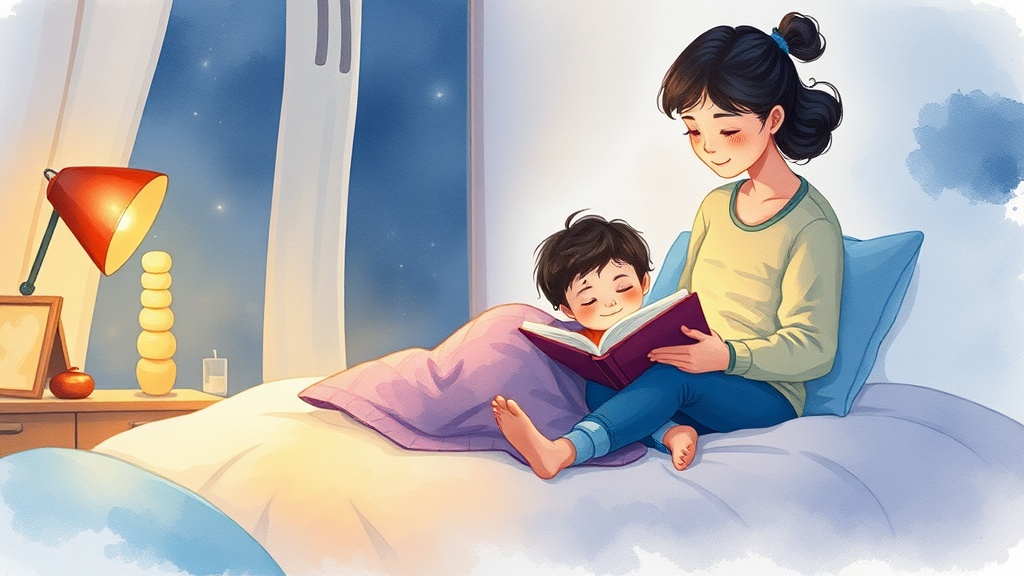
Too short and your child feels shortchanged. Too long and you're still reading at 9pm. Here's how to find the sweet spot for every age, from toddlers to primary schoolers.
If you've ever found yourself eleven pages into a picture book while your toddler is showing absolutely no signs of sleepiness — or cut a story short and been met with a full-scale protest — you've already discovered that story length matters. So how long should a bedtime story be, exactly? The honest answer is: it depends on your child's age, their temperament, and what you're hoping bedtime to look like. But there are some genuinely useful guidelines that can make the whole thing run a lot more smoothly.
Why Story Length Actually Matters at Bedtime
Bedtime stories aren't just about the story itself. They're a transition ritual — a bridge between the busy energy of the day and the stillness of sleep. That means the length of a story shapes the emotional tone of the whole experience.
A story that's too brief can feel rushed, leaving children unsettled rather than soothed. A story that runs too long, on the other hand, can have the opposite effect: kids get a second wind, start asking questions, want to negotiate just one more chapter, and suddenly it's 9:15pm and nobody is calm.
Getting the length right also helps set a predictable bedtime structure, which research consistently shows helps children fall asleep faster and with less resistance. Children feel safe when they know what to expect — and a story with a clear, satisfying ending signals that sleep is next.
How Long Should a Bedtime Story Be? A Guide by Age
Here's a rough framework to work from. Every child is different, so treat these as starting points rather than strict rules.
Ages 2–3: 5–8 minutes Toddlers have short attention spans, and that's completely normal. At this age, a single picture book (typically 10–14 pages of simple text) is plenty. You're not aiming for a narrative arc — you're aiming for a cosy, repetitive, rhythmic experience that helps their nervous system wind down. Books with repeated phrases or simple rhymes work brilliantly here. If they ask for the same book every single night, that's not boring — that's exactly what they need.
Ages 3–4: 8–12 minutes Preschoolers can follow a slightly more involved story now, and they often love stories with a clear problem and resolution. One picture book, or a short original story told aloud, fits nicely into this window. At this age, how you read matters as much as what you read — slow your voice down, pause at the exciting bits, and let the story do its sleep-inducing work.
Ages 4–6: 10–15 minutes Children in this range are usually ready for a bit more. They can hold a narrative in their heads, anticipate what might happen next, and genuinely engage with characters. A longer picture book, two shorter ones, or the first chapter of a very simple chapter book can all work well. This is often the golden age of bedtime stories — kids are engaged but not so stimulated that stories backfire.
Ages 6–8: 15–20 minutes By early primary school age, many children are ready for chapter books read in installments. One chapter per night is a natural unit — it provides a satisfying ending point while leaving them wanting more (in a pleasant, anticipatory way, not an agitated one). If your child is a big reader themselves, sharing a book you read aloud together can feel special and distinct from the reading they do independently.
Ages 8–10: 15–25 minutes Older children in this group often still love being read to, even if they'd never admit it. Chapter books, longer stories, or even age-appropriate audiobooks can all serve the bedtime story function. At this age, the ritual of shared reading is as valuable as the sleep benefit — it's connection time that children remember fondly for years.
Signs You've Got the Length Right (and Wrong)
Length guidelines are only useful if you know what you're looking for. Here are some telling signs:
The length is working when:
- Your child is visibly relaxing during the story — eyes going soft, body stilling
- They're engaged but not hyperactive
- The end of the story feels like a natural stopping point, not a cliff-hanger
- Lights-out after the story doesn't trigger a battle
The length might be off when:
- They're bouncing on the bed halfway through (probably too long, or too exciting)
- They're begging for more the moment you finish (possibly too short — or just a very good book)
- You're still reading 40 minutes after you started (this one is for you to notice, not them)
- They fall asleep before the end regularly (possibly too long for their current stage)
How to End a Bedtime Story Well
However long the story runs, the ending matters. A clear, calm conclusion helps children mentally close the loop and begin settling. Avoid stopping mid-chapter or in a moment of high tension unless you have to — unresolved narrative creates cognitive arousal, which is the opposite of what you want.
If you're making up stories on the fly (which many parents do brilliantly), try to build in a satisfying ending: the character solves their problem, gets home safely, or simply falls contentedly asleep themselves. Stories where the hero drifts off to sleep at the end are a classic for good reason — they model exactly the behaviour you're hoping for.
For parents who find it hard to invent a fresh, well-paced story every night, apps like Dreamtime generate a brand-new personalised bedtime story each evening, calibrated to your child's age and interests, with built-in narration — so the pacing and length are already sorted for you.
A Few Practical Tips to Make It Easier
- Keep your shortlist short. Having 3–4 books you rotate through is less overwhelming than facing a whole shelf at 7:45pm.
- Give a five-minute warning. "One more story, then lights out" works much better when it's said before the last story, not after.
- Don't negotiate mid-story. Decide the length before you begin, not in response to pleading.
- Let them choose. Within limits you set, giving children agency over which story is read reduces bedtime battles significantly.
- It's okay to be consistent. The same story length, same number of books, same routine every night isn't boring — it's reassuring.
The Bottom Line
There's no single perfect answer to how long a bedtime story should be — but the guidelines above give you a solid, age-appropriate starting point. What matters most is that story time feels calm, connected, and predictable, with a clear ending that leads naturally into sleep. Get those things right, and the exact number of minutes will sort itself out fairly quickly.
And if finding the right story is the hard part? That's a very solvable problem. The ritual itself — your voice, the lamplight, the winding-down together — is what your child will carry with them long after they've forgotten the plots.
Give your child a new story every night
Dreamtime creates personalised bedtime stories with beautiful illustrations, tailored to your child, every single night.
Start your free trial →