How to Help Your Child Stop Talking Themselves Awake at Bedtime
Dreamtime
15 August 2026
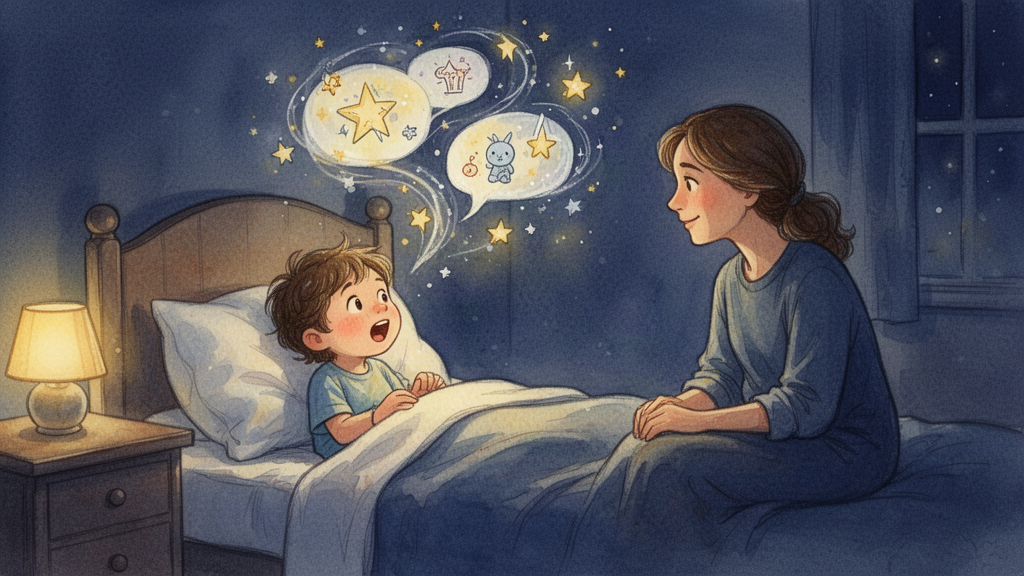
Some children fall quiet at bedtime, but others seem to get more chatty the moment the lights go off, asking questions, narrating their day, or inventing entire conversations. Here's why it happens and how to gently guide your child from chatter to calm.
You've done the bath, the pyjamas, the teeth, the story. You switch off the big light, kiss your child goodnight, and close the door softly behind you, only to hear a stream of chatter start up from the darkness. Sometimes it's questions ("Why do spiders have eight legs? Do you love me the most? What happens when we die?"). Sometimes it's a monologue about dinosaurs, or a replay of every detail of the school day. Either way, the talking doesn't stop, and neither does bedtime.
This is an incredibly common phase, especially in children aged 3 to 8, and it's rarely about defiance. Understanding what's actually happening in your child's mind at this moment can help you respond in a way that soothes rather than stalls.
Why Children Talk More, Not Less, at Bedtime
It seems counterintuitive: shouldn't a tired child go quiet? But bedtime is often the first moment all day when a child's brain isn't being pulled in six directions by school, siblings, screens, and activities. Once the room goes still, everything they've been holding onto surfaces.
There are a few common drivers behind bedtime chatter:
- Sensory shutdown, mental startup. With the lights off and the room quiet, your child's mind has nothing else to focus on except its own thoughts. For a busy, developing brain, that silence can feel loud.
- Connection-seeking. Talking keeps you in the room. If your child is enjoying the one-on-one attention of bedtime, extending the conversation is an easy way to extend your presence.
- Processing the day. Children don't always have the words or emotional tools to process big feelings in the moment they happen. Bedtime becomes the delayed download.
- Genuine curiosity. Younger children are constantly building a model of how the world works, and the quiet, safe space of bed is often when the biggest, most existential questions bubble up.
- Anxiety in disguise. Sometimes talking is a stalling tactic that masks worry: about the dark, about being alone, about something that happened at school.
None of these are problems to be shut down. They're signals to be read.
Give the Chatter a Time and a Place — Before Lights Out
Rather than fighting the urge to talk once your child is in bed, build a dedicated "chat window" into your routine before the lights go off. This might be five or ten minutes sitting on the edge of the bed where your child can ask anything, tell you anything, or simply talk through their day.
Try a simple prompt structure to guide it, such as:
- "What was the best part of today?"
- "Was there a tricky bit?"
- "Is there anything on your mind for tomorrow?"
Giving this chatter a designated slot, with a clear start and end, meets the underlying need for connection and processing without letting it bleed into the actual settling period.
Use a "Save It for Tomorrow" Jar or Notebook
For children who are naturally curious and love firing off questions ("But why does the moon follow the car?"), a bedside notebook or "question jar" can work wonders. When a new thought pops up after lights out, gently say, "That's a brilliant question — let's write it down and talk about it properly tomorrow."
This does two things: it validates the thought instead of dismissing it, and it removes the pressure to answer (or engage) right at the moment you're trying to leave the room. Many parents find that just the act of "capturing" the thought is enough to help a child let it go for the night.
Lower the Temperature With a Predictable Wind-Down Script
Children often talk more when they're overstimulated, not less. If the runway into bed is rushed or chaotic, their minds arrive at the pillow still racing. A slow, predictable sequence in the final 20 minutes before bed, dim lights, quiet voices, the same few steps in the same order, signals to the brain that it's time to shift gears.
A calm story is one of the most effective tools here, because it gives an already-active imagination somewhere productive to go. Instead of generating its own stream of questions and ideas, your child's mind can follow someone else's narrative instead. This is one of the reasons many families use a personalised story app like Dreamtime as the final step before lights out: a new, gentle story each night, tailored to your child's name, age, and interests, gives their imagination a place to land rather than a blank, quiet room to fill with chatter.
Respond to the Content, Not Just the Behaviour
If the talking includes recurring themes, worries about death, fear of the dark, anxiety about a friendship, treat those as real information rather than delay tactics. A child who keeps circling back to "what if you don't come and get me in the morning" is telling you something important, even if it's 8:47pm and you're desperate for them to just go to sleep.
You don't need to solve everything on the spot. A simple acknowledgement often works best: "That's a big feeling to have at bedtime. We don't need to figure it all out right now, but I hear you, and we're safe." Save the deeper conversation for a calmer, more awake moment the next day, perhaps during that dedicated chat window the following evening.
A Gentle Reminder
Bedtime chatter, while exhausting for tired parents, is often a sign of a child who feels safe enough to think out loud with you. The goal isn't to shut down the talking altogether, it's to give it a home earlier in the routine, so that by the time the lights go off, your child's mind already feels heard, emptied out, and ready to rest.
With a little structure and patience, those long, meandering bedtime conversations can shrink from forty-five minutes to five, and both of you can get back to actually enjoying the last few quiet minutes of the day together.
Give your child a new story every night
Dreamtime creates personalised bedtime stories with beautiful illustrations, tailored to your child, every single night.
Start your free trial →