How to Help Your Child Stop Asking for the Same Bedtime Stuffed Animal's "Opinion" on Everything
Dreamtime
1 October 2026
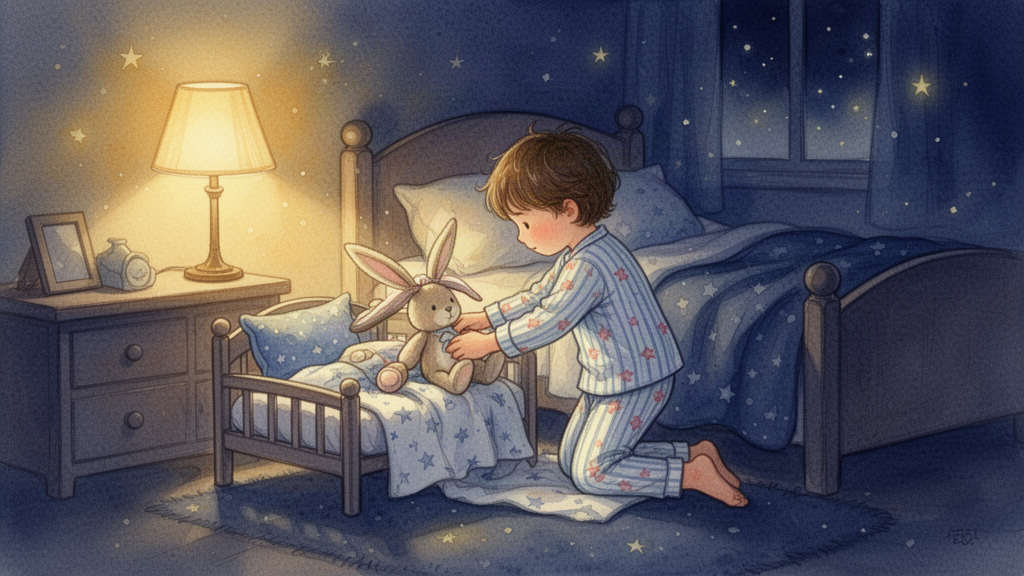
When your child starts consulting a stuffed rabbit before agreeing to anything at bedtime, it can feel like a stalling tactic. In reality, it's a sign of healthy imaginative development, and there are simple ways to work with it rather than against it.
"Wait, I have to ask Mr. Buttons first." If you've heard some version of this sentence at bedtime, you know exactly how it goes. Your child picks up a well-loved stuffed animal, pauses dramatically, tilts their head as if listening, then reports back: Mr. Buttons says he's not tired yet. Or Mr. Buttons doesn't want the light off. Or, most maddening of all, Mr. Buttons disagrees with literally every instruction you've just given.
It's easy to read this as a clever new stalling tactic, and sometimes it is. But it's also something more interesting: a real developmental milestone playing out in real time, right when you're trying to get everyone to sleep. Understanding what's actually happening can help you respond in a way that works with your child's imagination instead of fighting it.
Why Stuffed Animals Suddenly Get a Voice
Somewhere between ages 2 and 6, most children go through a stage of rich imaginative and symbolic play. They start giving toys personalities, backstories, preferences, and opinions. This isn't random. It's a sign that your child is developing "theory of mind," the ability to understand that other beings (even pretend ones) have thoughts and feelings separate from their own.
Giving a stuffed animal a voice is also a safe way for children to express things they don't feel comfortable saying directly. It's much easier to say "Mr. Buttons is scared of the dark" than "I'm scared of the dark." The toy becomes a stand-in, a puppet through which bigger feelings can be tested out without the vulnerability of claiming them outright.
At bedtime specifically, this behaviour often spikes because bedtime is already emotionally loaded. It's the end of the day, the point of separation from you, and the moment when worries that got pushed aside during a busy day tend to surface. The stuffed animal becomes a convenient mouthpiece for all of it.
When It's Imagination and When It's Stalling
Not every "Mr. Buttons says no" is a profound emotional disclosure. Plenty of the time, it's a perfectly ordinary four-year-old discovering that this game is a fantastic way to delay lights out. Both things can be true, and you don't need to diagnose which one is happening every single night. A few signs it's leaning towards genuine feeling rather than stalling:
- The "opinions" relate to specific fears (the dark, being alone, a nightmare from last week)
- Your child seems a little anxious or clingy while doing the voice, not just playful
- It happens consistently around one particular issue, rather than a new objection every night
If it's mostly stalling, the content of what the toy "says" will be wildly inconsistent and often escalate the longer you engage with it. That's your cue to gently wrap things up.
How to Respond Without Shutting Down the Game
The goal isn't to ban the stuffed animal from having opinions, that would mean shutting down a healthy piece of imaginative play. The goal is to give the game a container so it supports bedtime rather than derailing it.
Acknowledge the toy briefly, then move things along. "Oh, Mr. Buttons isn't tired? That's funny, because it's his bedtime too. Let's tuck him in first." This validates the game for two seconds and then redirects, rather than ignoring it (which can feel dismissive) or engaging endlessly (which teaches that the toy is an effective delay tool).
Give the toy a job, not a debate. Instead of letting the stuffed animal issue demands, give it a role in the routine. "Mr. Buttons gets to pick which pyjama top you wear" or "Mr. Buttons is in charge of making sure the blanket is tucked in properly." This channels the imaginative energy into the routine instead of against it.
Use the toy to surface real worries, if you suspect there are some. If you sense actual anxiety behind the game, try asking the toy directly: "Mr. Buttons, are you worried about something?" Children will often answer through the toy things they wouldn't say as themselves. You can then respond to the toy with reassurance, which indirectly reassures your child too, without putting them on the spot.
Set the opinion-asking boundary ahead of time, not in the moment. At a calm point during the day, you might say, "Mr. Buttons can tell us his favourite bedtime story, but once we've said goodnight, he goes to sleep too, no more talking." Children (and toys) respond better to limits set outside the heat of the moment.
Building a Routine That Gives the Imagination Somewhere to Go
One of the most effective long-term fixes isn't about the stuffed animal at all, it's about giving your child's imagination a proper outlet earlier in the bedtime routine, so there's less pressure to invent new games once the lights are meant to be off. A story that lets your child's own interests, worries, and favourite characters take centre stage can do a lot of this work for you.
This is one of the reasons personalised story apps like Dreamtime can help here. Because each story is built around your child's name, age, and interests, it gives their imagination somewhere rich and satisfying to go before lights out, rather than leaving it to spill over into a nightly negotiation with a stuffed rabbit. When the story itself has already scratched that imaginative itch, there's often less appetite for inventing a whole second round of make-believe once you're trying to leave the room.
A Gentle Final Thought
A child who gives their stuffed animal opinions, fears, and preferences is a child whose imagination and empathy are developing exactly as they should. It's not a problem to be eliminated, just a habit that sometimes needs a bit of structure around it. With a few small boundaries, a role for the toy in the routine, and a story earlier in the evening that gives all that imaginative energy somewhere to land, you can keep the magic of the game while still getting everyone, Mr. Buttons included, off to sleep on time.
Give your child a new story every night
Dreamtime creates personalised bedtime stories with beautiful illustrations, tailored to your child, every single night.
Start your free trial →