How to Help Your Child Stop Asking for Water, Snacks, and the Toilet After Lights Out
Dreamtime
10 August 2026
Endless requests for water, snacks, or "one more wee" after lights out can turn bedtime into a nightly negotiation. Here's why these post-lights-out requests happen and a practical, step-by-step plan to reduce them for good.
You've done the bath, the pyjamas, the teeth, the story, the hugs. Lights are off. You're halfway down the stairs when you hear it: "I need water." Five minutes later: "I need a wee." Then: "I'm hungry." It's not really about the water, the wee, or the snack — but that doesn't make it any less exhausting when it happens every single night.
This particular flavour of bedtime stalling is one of the most common complaints parents bring up with sleep consultants, and the good news is it's also one of the most fixable, once you understand what's actually driving it.
Why This Happens (It's Rarely About Thirst or Hunger)
For most children aged 2–8, these repeated requests aren't manipulative — they're a mix of physiology and psychology working against you at exactly the wrong time.
Genuine physical needs get noticed more in the quiet. During the business of the day, kids don't register a dry mouth or a full bladder. But lying still in a dark, quiet room with nothing else to focus on, suddenly every small sensation becomes noticeable — and worth mentioning.
Separation anxiety dressed up as a practical request. A request for water is a much more acceptable way to get you back in the room than "I don't want you to leave." Young children often haven't developed the emotional vocabulary to say what they actually mean, so the need comes out sideways.
It works — and they know it. If asking for water has ever bought an extra 10 minutes with you, your child has learned (completely unconsciously) that it's a reliable way to delay sleep and get more connection. Children are remarkably good at spotting which levers get results.
Genuine overtiredness. Paradoxically, an overtired child's body produces more cortisol and adrenaline, which can make them more alert and fidgety right when they should be winding down — leading to more complaints, not fewer.
Close the Loopholes Before Lights Out
The most effective fix isn't a stricter response after the request — it's removing the reason for the request in the first place.
- Do a "bedtime check-in" ritual. Right before the final story, run through a simple, consistent checklist together: toilet, water, are your feet cold, is your teddy in bed. Make it a game rather than a chore — some families call it the "sleepy checklist" or give it a silly name the child chooses themselves.
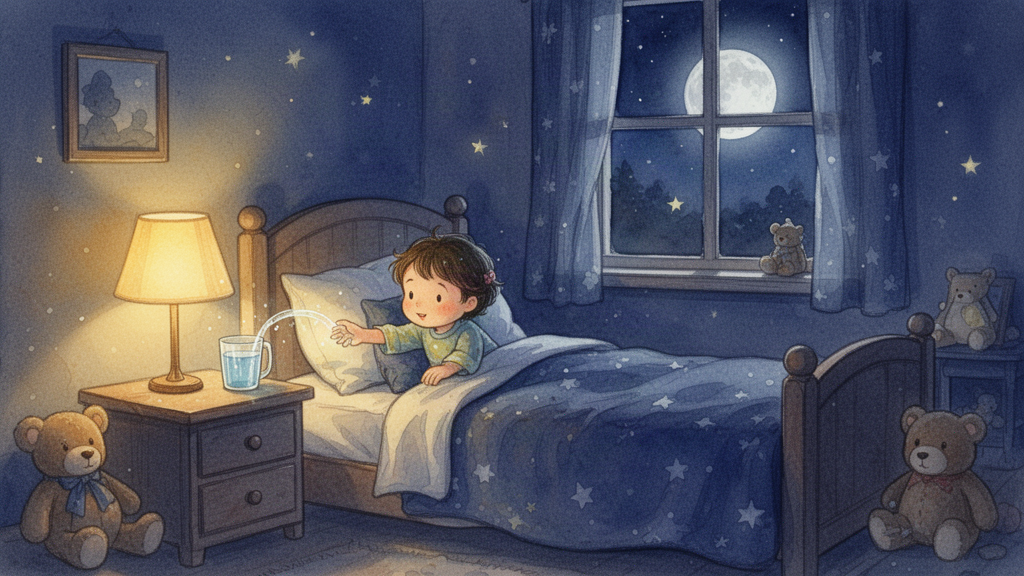
- Leave a water cup within reach. A small spill-proof cup on the nightstand removes the need to call out or come downstairs entirely. If they're thirsty, they can solve it themselves.
- Offer a bedtime snack that actually helps. A small, sleep-friendly snack (like a banana or a few oat crackers) 20–30 minutes before bed can prevent genuine hunger from surfacing later.
- Dim lights and reduce stimulation 45 minutes before bed. An overstimulated child is more likely to seek out reasons to reconnect with you. A calmer wind-down reduces the emotional charge that fuels stalling.
Respond in a Way That Doesn't Reward the Behaviour
Once lights are out, how you respond to a request matters just as much as the routine that came before it.
Keep it brief, boring, and warm. Answer the request in the fewest words possible, without irritation and without extra conversation. "Here's your water. Night night, love you." Avoid the temptation to chat, negotiate, or explain — the more engaging your response, the more effective the strategy becomes for your child.
Use a "one trip" rule. Tell your child in advance, during the day rather than in the heat of the moment, that they get one check-in after lights out for anything they need. Beyond that, whatever it is can wait until morning (with the obvious exception of being unwell). Consistency here is everything — if the rule holds most nights but caves on others, it will take longer to work.
Try a bedtime pass. A physical token — a card, a laminated ticket, anything tangible — that your child can redeem once per night for one extra need or one extra hug. Once it's used, it's gone until tomorrow. Many parents find the physical object makes the boundary feel fairer and more concrete to a young child than a verbal rule.
Address the Emotional Need Directly
If you suspect connection-seeking is behind the requests more than genuine thirst or hunger, tackle that need head-on earlier in the routine rather than trying to out-strategise it later.
Spend a few minutes of undistracted, phone-free attention before the final goodnight — even five minutes of focused connection can significantly reduce a child's need to manufacture reasons to call you back. This is also where a calming, absorbing bedtime story earns its keep: a story your child is genuinely engaged in gives them a satisfying sense of closure, rather than leaving them wanting more of you the moment the light goes off. In the Dreamtime app, each story is personalised with your child's name and interests, which many parents find gives the wind-down that extra bit of emotional "fullness" that a generic book doesn't quite achieve — helping the goodbye at the end of the story feel more complete.
What to Expect as You Make the Change
Don't expect this to resolve in one night. If the pattern is established, you may see it get slightly worse for two or three nights before it improves — this is completely normal and often called an "extinction burst" by sleep specialists. Hold the boundary gently but consistently, and most families see a real difference within one to two weeks.
Bedtime stalling of this kind isn't a sign you're doing anything wrong — it's simply a very normal stage that most children pass through as they test boundaries and process the separation that sleep requires. With a predictable routine, a few practical fixes, and a calm, consistent response, those repeated trips back out of bed will become far less frequent — and the last few minutes of the day can go back to being peaceful for everyone.
Give your child a new story every night
Dreamtime creates personalised bedtime stories with beautiful illustrations, tailored to your child, every single night.
Start your free trial →