How to Help Your Child Stop Asking to Sleep With the Door Open (Without a Nightly Standoff)
Dreamtime
25 September 2026
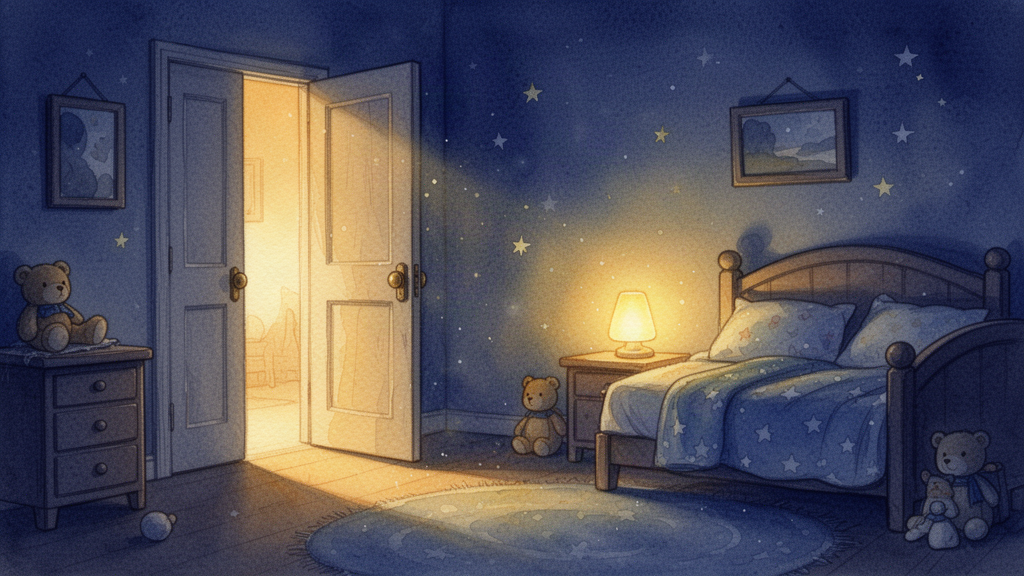
The door-open, door-closed debate is one of the most common bedtime battles, and it's rarely about the door at all. Here's what's really going on and how to find a solution that lets everyone sleep soundly.
"Leave the door open!" It's a phrase uttered in homes everywhere, night after night, sometimes followed by a precise instruction about exactly how many inches of gap are acceptable. For many families, the door becomes a nightly negotiation all its own, separate from the lights, the water, and the extra story. If you've found yourself creeping back to adjust a door by a fraction of an inch to satisfy a very specific request, you're not alone, and there are good reasons this happens.
Why the Open Door Matters So Much
For young children, a closed door can feel like a wall between them and safety. It's not really about seeing into the hallway. It's about what the open door represents: connection to you, reassurance that the rest of the house still exists, and an escape route if something feels wrong.
This is especially common between ages 3 and 7, when children's imaginations are developing rapidly but their ability to reason away fears hasn't quite caught up. A closed door can amplify the feeling of being alone, cut off, or unable to call for help. Some children also associate a closed door with being "shut in" or punished, even if that's never how it's been used in your home.
For other children, it's more sensory than emotional. They like hearing familiar household sounds, the hum of the television, footsteps, muffled conversation, because silence itself feels unsettling. The open door isn't about fear exactly, it's about maintaining a thread of connection to ordinary life while they drift off.
Work Out What's Really Being Asked For
Before you try to change the habit, spend a few nights simply observing. Ask your child directly during the day, when there's no bedtime pressure attached: "What do you like about having the door open?" You might get answers like:
- "So I can hear you."
- "So the monsters can't get trapped in with me."
- "So it's not so dark."
- "So I know you haven't left."
Each of these points to a different underlying need, and each has a slightly different fix. A child worried about darkness needs a light solution. A child worried about connection needs reassurance and check-ins. A child worried about monsters needs help separating imagination from reality. Knowing which one you're dealing with saves you from offering solutions that miss the point entirely.
Practical Fixes That Actually Work
Try a compromise position first. A door open just a crack, propped with a doorstop at a fixed angle, often satisfies the need for connection without flooding the room with hallway light and noise. Let your child help choose the exact gap so they feel some ownership over the decision.
Add a landing light or dim hallway lamp. If part of the appeal is the light spilling in, a small plug-in light left on in the hallway can replicate that effect even with the door mostly closed.
Use a sound machine to fill the silence. If your child craves the "sound of life" rather than an open door specifically, white noise or soft ambient sound can replace that need. It also has the bonus of masking creaky floorboards and muffled conversation that might otherwise wake them.
Offer a check-in schedule instead of an open door. Some children just want proof you haven't vanished. Try telling them, "I'll pop my head in after I finish the dishes," and follow through reliably. Trust built through consistency often reduces the need for a visual connection through an open door.
Move gradually, not suddenly. If your ultimate goal is a closed door (perhaps for noise or light reasons in a shared living space), shift the gap gradually over a couple of weeks rather than closing it all at once. Small, predictable changes are far easier for children to accept than sudden new rules.
When It's Really About Separation, Not the Door
Sometimes the open-door request is a stand-in for a bigger worry about separating from you at the end of the day. If your child is going through a big transition, a new sibling, starting school, a house move, the door might be the one thing they feel they have control over when everything else feels uncertain. In these cases, addressing the underlying transition directly, through extra daytime connection or reassurance, often eases the nightly door battle without you ever having to discuss the door itself.
It also helps to build in a strong wind-down connection before lights out, so your child goes to sleep already feeling secure rather than trying to manufacture that security through the door. A calm chat about their day, a cuddle, or a story that's just for them can do a lot of that emotional work in advance. This is where a personalised story can genuinely help: hearing their own name and interests woven into a gentle tale gives children a felt sense of being seen and cared for right before sleep, which can quietly reduce the need to keep the door open as a proxy for closeness. Dreamtime creates a new story like this every night, tailored to your child's age and interests, as one small piece of a calming wind-down routine.
Keep the Focus on Feeling Secure, Not on Winning
It's tempting to treat the door as a battle of wills, especially on nights when you're exhausted and just want to leave the room. But like most bedtime sticking points, the request usually has a reasonable emotional root. Once you address that root cause, whether it's fear of the dark, a need for connection, or simple sensory preference, the door itself tends to matter less.
Be patient with the process. Some children will happily accept a closed door within a week of trying a new light or sound solution. Others need months of small, consistent steps. Either way, you're not indulging a whim, you're helping your child build the sense of security that will eventually let them fall asleep confidently, door open or closed.
Give your child a new story every night
Dreamtime creates personalised bedtime stories with beautiful illustrations, tailored to your child, every single night.
Start your free trial →