"Will I Die?" Big Questions at Bedtime: How to Answer Your Child's Deepest Thoughts When the Lights Go Out
Dreamtime
11 November 2026
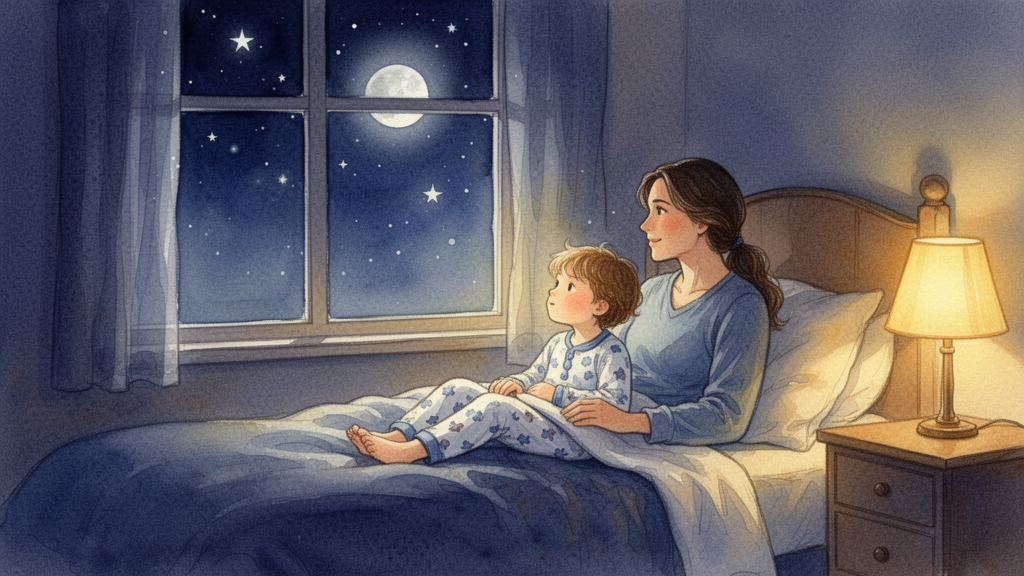
Just as you reach for the light switch, your child asks, "Will I die one day?" Big, deep questions often surface at bedtime, and they can leave parents lost for words. Here is how to answer honestly, calmly and kindly, so your child feels safe enough to sleep.
The room is dim, the pyjamas are on, the story is finished. Then a small voice says, "Mummy, will I die one day?" Or perhaps it is, "Where was I before I was born?" or "What happens when the universe ends?" Your heart skips, your mind races, and the bedtime you had planned suddenly feels very far away.
If this sounds familiar, you are in good company. Big, philosophical questions are a normal part of development, and they have a habit of arriving at bedtime. The good news is that you do not need perfect answers. You need a calm voice, a little honesty, and a few simple tools.
Why Big Questions Come Out at Bedtime
There is a reason these questions rarely appear at 10am on a busy Tuesday. During the day, your child is stimulated by play, friends, noise and activity. At bedtime, everything slows down. With the distractions gone, their thoughts have room to wander, and the quiet gives deeper curiosity a chance to surface.
Bedtime is also when children feel safest and most connected to you. Asking a scary or enormous question is a bit like testing whether the world is a secure place. They are not just looking for facts. They are checking that you are still there and still steady.
Between ages four and seven, children also begin to grasp that death is permanent and that it applies to everyone, including them. This is a major cognitive leap, and it can feel unsettling. Seeing it as a sign of growing understanding, rather than a problem to fix, can help you stay calm.
Start by Getting Curious, Not Answering Straight Away
It is tempting to leap in with a long explanation or to shut the conversation down to protect them. Try a gentler first step: ask what they are thinking.
- "That's a big question. What made you think about that?"
- "What do you think happens?"
- "Is there something you've heard or seen that got you wondering?"
Often, a child's worry is much smaller or more specific than you expected. A bird they saw on the pavement, a character in a film, or a comment from a friend may be behind it. Their own answer tells you how much they actually want to know, so you can match your response to their level rather than overloading them.
Keep Answers Honest, Simple and Age-Appropriate
Children can usually tell when they are being brushed off, and vague or untrue answers tend to create more anxiety, not less. Aim for short, truthful and warm.
Ages 2 to 4: Keep it very concrete. Young children think in the here and now, so a few words are plenty. "Everything alive eventually stops living, but that is a very, very long time away for you. Right now you are healthy and safe and I'm right here."
Ages 5 to 7: They want a little more logic. You might say, "Yes, one day, when people are very, very old, their bodies wear out and stop working. Most people live for a really long time, and you have almost all of your life ahead of you."
Ages 8 to 10: Older children can handle more nuance and often enjoy talking about beliefs, science and meaning. Share your family's views, whether religious, spiritual or scientific, and be comfortable saying, "People believe different things, and nobody knows for certain. Here is what we believe."
Avoid euphemisms such as "going to sleep" for death. For a child who is already nervous about bedtime, these can accidentally link sleep with something frightening.
It Is Fine to Say "I Don't Know"
Some questions simply have no answer, and pretending otherwise can backfire. Saying "That is one of the biggest questions people have ever asked, and I don't know for sure" models something valuable: that uncertainty is allowed, and that you can feel safe even without every answer.
You can follow it with something grounding: "What I do know is that I love you, you are safe, and we can wonder about it together tomorrow." Offering to continue the conversation in daylight is especially useful. It validates their question without letting it take over the night.
Close the Conversation Gently
After a heavy talk, your child needs help shifting back into sleep mode. Try a short wind-down:
- Acknowledge the feeling. "It can feel a bit strange to think about big things like that."
- Anchor them in the present. Notice the warm blanket, the soft light, the sound of your voice.
- Give them something to do with the thought. Some families keep a "worry and wonder" notebook by the bed, where questions are jotted down for tomorrow.
- Move to something cosy. A few slow breaths, a back rub, or a calm story helps the body follow where the mind is heading.
Stories are particularly good at this stage. A gentle tale about a curious character who asks big questions and finds comfort among people who love them lets your child explore the same feelings from a safe distance. If you would like something tailored to the moment, Dreamtime can create a personalised bedtime story featuring your child's name and interests, so you can ask for a soothing adventure about wonder and belonging and let the narration carry them toward sleep.
When to Seek Extra Support
Occasional deep questions are healthy. But if your child seems persistently distressed, has trouble sleeping for several weeks, avoids bedtime because of fears about death, or shows signs of anxiety during the day, it is worth speaking to your GP or school. A professional can help work out whether something else, such as a recent loss or a wider anxiety, is behind it.
You Do Not Need All the Answers
When your child asks a question that makes your stomach flip, remember that what matters most is not the perfect answer. It is that they asked you. A question at bedtime is a sign of trust, a little hand reaching out in the dark.
Stay calm, stay honest, keep it simple, and let them know the door is always open. With your steady presence, even the biggest questions can become part of a bedtime that ends in comfort and sleep.
Give your child a new story every night
Dreamtime creates personalised bedtime stories with beautiful illustrations, tailored to your child, every single night.
Start your free trial →