How to Help Your Child Stop Asking a Million Questions at Bedtime (Without Shutting Down Their Curiosity)
Dreamtime
25 August 2026
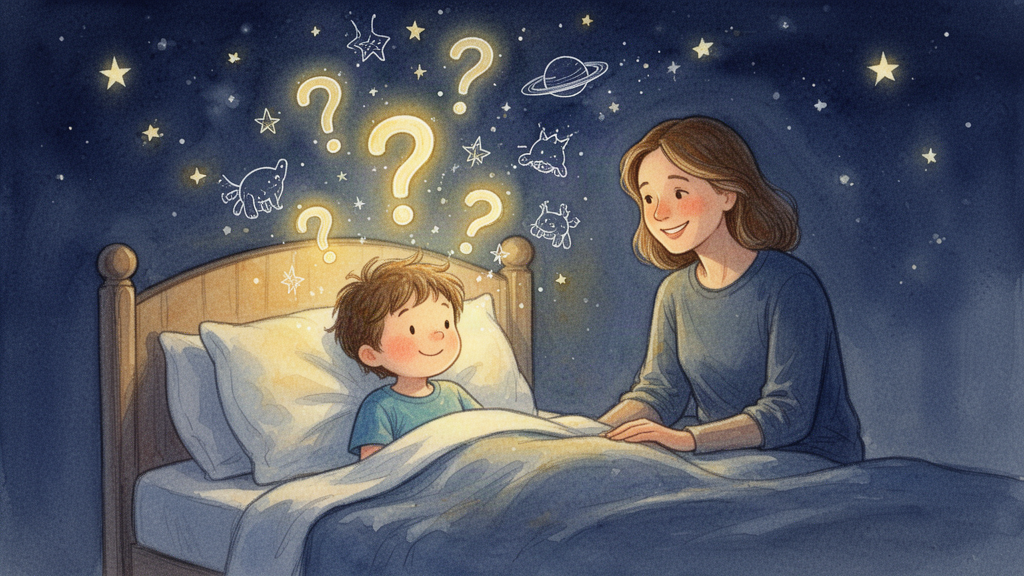
Why do children suddenly turn into tiny philosophers the moment the lights go out? Here's why the bedtime question spiral happens and how to satisfy your child's curiosity without derailing sleep.
You've done the bath, the pyjamas, the teeth, the story. Lights are about to go off. And then it starts: "Why do we have eyebrows?" "What happens when you die?" "Why is the sky dark now but blue in the day?" "Do fish sleep?" Suddenly you're not tucking your child in — you're fielding a philosophy seminar at 7:45pm.
If this sounds familiar, you're not alone, and your child isn't trying to wind you up (even though it can feel that way after the fifth question about black holes). The bedtime question spiral is real, common, and — once you understand why it happens — much easier to manage without shutting your child down or losing an hour of your evening.
Why Bedtime Brings Out the Big Questions
There's a reason these questions almost never come up at the breakfast table but flood out the second the room goes quiet. A few things are happening at once:
Their brain is finally still. During the day, kids are busy doing — running, playing, learning, reacting. Bedtime is often the first genuinely quiet, unstimulated moment they've had all day, and that stillness is exactly when stray thoughts bubble up. The question about death or dinosaurs or where the sun goes has probably been sitting there since 2pm, waiting for a gap.
They've learned it delays sleep. Even very young children pick up quickly that a good, thoughtful question earns them a few extra minutes with you. This isn't manipulation in a scheming sense — it's a completely logical response to the fact that attention and connection feel good, and bedtime is often the most focused attention they get all day.
Darkness and quiet make bigger, scarier thoughts feel louder. Existential questions ("Will you die?" "Will I die?") often surface at night because the absence of daytime distraction leaves room for anxiety to take centre stage. This is developmentally normal, especially between ages 4 and 8, as children start to grasp permanence and mortality for the first time.
They genuinely want to understand the world. Curiosity doesn't clock off at bedtime. If anything, a calm, safe, one-on-one moment with a trusted adult is the ideal environment for a child to ask the things they've been too busy or shy to ask elsewhere.
How to Tell the Difference: Curiosity vs. Stalling
Not every bedtime question deserves the same response. It helps to quickly sort what you're hearing into one of three buckets:
- Genuine curiosity — "Why do birds migrate?" "How do plants grow?" These are real, engaged questions about the world.
- Anxiety in disguise — "What if there's a fire tonight?" "Will you still be here in the morning?" These need reassurance, not a factual answer.
- Stalling — "But what's your favourite colour? And what was mine when I was a baby? And what's yours now?" These tend to snowball in an obviously delaying pattern.
You'll usually know which one you're dealing with by the tone. Curiosity feels light and interested. Anxiety feels urgent or repetitive. Stalling feels like a a chain that never quite resolves.
What Actually Works
Give a short, honest answer — then a bridge to tomorrow. You don't need to explain the entire life cycle of a star at 8pm. A simple, true answer ("Stars are actually huge balls of burning gas, so far away they look tiny — I'll show you a picture tomorrow") satisfies curiosity without opening five new questions. Naming a specific time you'll follow up ("tomorrow at breakfast," "in the car") reassures them the question hasn't been dismissed, just parked.
Name what's happening for anxiety-driven questions. If your child asks something fearful, resist the urge to answer with facts first. Try: "That sounds like a worry, not just a question. You're safe, I'm right here, and nothing is going to happen tonight." Naming the feeling often does more to settle them than any explanation could.
Set the expectation before the questions start. Rather than reacting mid-spiral, try saying at the start of the wind-down routine: "You can ask me one big question tonight, and then it's time for sleepy brains." Kids respond surprisingly well to a clear, kind boundary set in advance rather than one that shows up as a "no" halfway through.
Create a "question jar" or notebook. For children who are natural over-thinkers, keep a small notebook by the bed. When a question pops up, write it down together ("great question, let's add it to the list") and promise to explore the answer the next day. This validates their curiosity while protecting the boundary of bedtime.
Fold curiosity into the story itself. One gentle way to satisfy a curious mind without opening the floodgates is to let their questions live inside the story rather than after it. A child obsessed with volcanoes, space, or why the ocean is salty can have those very interests woven directly into their bedtime story, so the wondering is happening during the wind-down, not delaying it. This is something we built Dreamtime around — each story is generated around your child's own interests and questions, so a curious mind gets to explore its favourite topics through a calm, sleepy narrative instead of a wide-awake interrogation.
When to Dig Deeper
If bedtime questions are consistently anxious in tone — repeated worries about safety, death, or being left alone — rather than curious, it's worth gently exploring this outside of bedtime too, during a calm daytime moment when there's no pressure to fall asleep afterwards. Most of this is a normal developmental phase, but persistent, distressing anxiety that disrupts sleep for weeks is worth mentioning to your GP or health visitor.
The Takeaway
A child who won't stop asking questions at bedtime is, in almost every case, a child whose brain is doing exactly what it's supposed to do: processing the day, exploring the world, and reaching for connection with you before sleep. You don't need to answer everything, and you don't need to shut it down either. A short answer, a loving boundary, and a promise to pick the thread up tomorrow is usually all it takes to protect both their curiosity and your evening.
And on the nights when the questions just won't stop coming? It might be a sign your child has a specific interest bursting to get out — one that a story built just for them could quietly satisfy, long before the lights go off.
Give your child a new story every night
Dreamtime creates personalised bedtime stories with beautiful illustrations, tailored to your child, every single night.
Start your free trial →