10 Bedtime Story Ideas When Your Brain Goes Blank at 8pm
Dreamtime
22 April 2026
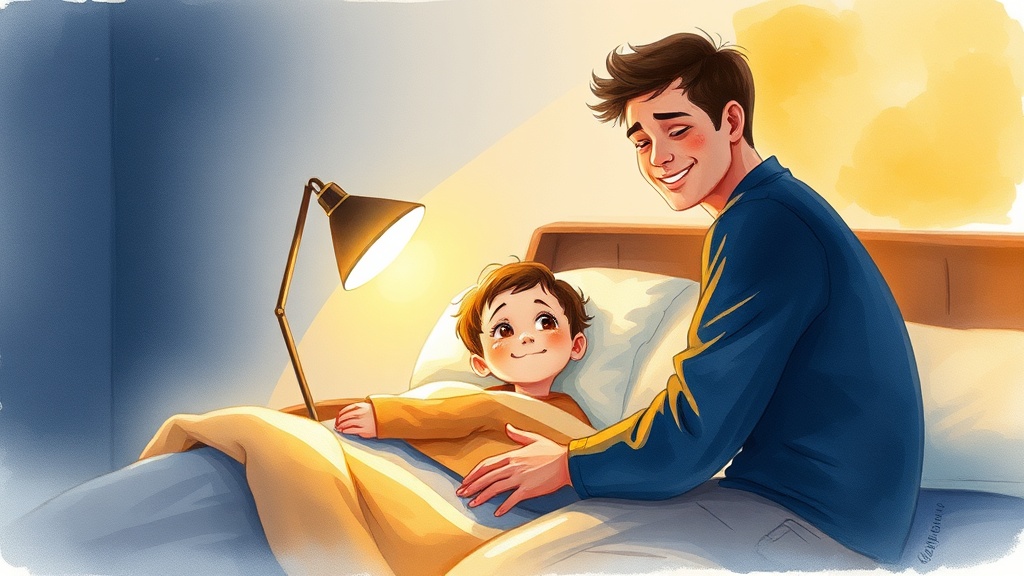
It's 8pm, your child is waiting, and your mind has gone completely blank. Every parent knows the feeling. Here are 10 genuinely useful bedtime story ideas to rescue you tonight — and every night after.
It's ten past eight, your child is in bed with their eyes half-open and their arms outstretched, and you've just been asked for a story. Your brain, which has been running at full capacity since approximately 6am, has nothing. Not a character, not a plot, not even a setting. If you're searching for bedtime story ideas for parents who can't think of one, you are in extremely good company — and you've come to exactly the right place. Below you'll find ten reliable ideas that work even when your imagination has clocked off for the evening.
Why Bedtime Story Blank Spots Are So Common (And So Normal)
There's a reason this happens to almost every parent. By the time bedtime arrives, most of us have made hundreds of decisions across the day — about food, childcare, work, logistics, and about a thousand small negotiations involving snacks and screen time. Decision fatigue is real, and creative thinking is often the first casualty.
The good news is that children don't need elaborate stories. They need warmth, a familiar voice, and just enough narrative to help their minds drift away from the busyness of the day. The bar is genuinely lower than you think — which means any of the ideas below will do the job beautifully.
10 Bedtime Story Ideas When Your Mind Goes Blank
1. Your child, but tiny. Tell a story about a miniature version of your child — thumb-sized — who goes on an adventure in the garden or the kitchen. Everything familiar becomes magical when you're that small. A teacup is a swimming pool. A flower pot is a fortress.
2. The day in reverse. Walk backwards through everything your child did today, but give each moment a tiny twist. Breakfast becomes enchanted porridge. The walk to nursery becomes a journey through an enchanted forest. Children love hearing their own day reflected back to them, and it doubles as a lovely way to process it.
3. An animal who has the same problem your child had today. Did your child find it hard to share at playgroup? Tell a story about a beaver who didn't want to share his pile of sticks — and what happened next. Mirroring real feelings through animal characters is a classic technique that works at almost any age.
4. A magical version of your home. What if, at night, the toys came alive? What if there was a tiny door behind the radiator leading to another world? What if the family cat was secretly the guardian of a sleeping kingdom? Your own home is already full of story potential.
5. A child who can talk to one specific animal. Just pick an animal your child loves — a hedgehog, a whale, a parrot — and give your child the power to understand its language. Where do they go together? What does the animal need help with?
6. Something your child is currently obsessed with, but in a different setting. If your child loves dinosaurs, put them on a spaceship. If they love fairies, put them in a city. Take the thing they already adore and drop it somewhere unexpected. The contrast does half the storytelling work for you.
7. A problem-solving quest with three obstacles. This is the oldest story structure in the world for a reason: it works. A character needs something, faces three challenges, and succeeds. You can plug almost any character and any goal into this shape and it will hold. The three obstacles can be as simple as a locked gate, a sleeping giant, and a riddle.
8. A story about someone learning something your child is learning. Is your child getting used to sleeping in their own room? Starting a new nursery? Learning to use the toilet? There is enormous comfort in hearing a character go through the exact same thing and come out the other side feeling proud.
9. A bedtime story about going to sleep. Meta, but genuinely effective. Tell a story about a little bear, or a small rabbit, who is finding it very hard to fall asleep — and follow them as they slowly, slowly drift off. Describe the cosy feeling of a warm blanket. The sound of the wind outside. The softness of the pillow. You're not just telling a story; you're narrating your child gently to sleep.
10. Ask your child for three ingredients — then tell the story. This one hands the creative work back to them. Ask them to give you a character, a place, and a problem. Then you weave it together. Children are endlessly creative at this stage, and being the co-author of their own story is quietly magical for them.
The Simple Story Formula Worth Memorising
If you want something even more structured to fall back on, try this four-sentence starter whenever you're stuck:
Once upon a time, there was a [character] who wanted [something]. Every day, they tried to get it, but [something kept getting in the way]. Then one day, [something changed]. And from that day on, [life was different in some small, good way].
That's it. Four beats. You can spin an entire story out of that scaffolding in under five minutes, and children find it deeply satisfying — because it mirrors the shape of all the stories they already love.
When You'd Rather Not Have to Think at All
Some evenings, even ten good ideas feel like ten too many. If you'd love a fresh, personalised story waiting for you every night without any preparation, Dreamtime creates a brand-new bedtime story tailored to your child's name, age, and interests — complete with watercolour illustrations and narration. It's a lovely option for those nights when you genuinely have nothing left to give, and the story still needs to be wonderful.
A Note on Imperfect Stories
Here's the thing that every tired parent needs to hear: your child is not listening for narrative perfection. They're not waiting to spot a plot hole or a weak ending. They are listening for your voice. They are listening because you showed up, sat on the edge of their bed, and made something — however wobbly — just for them.
The stories that children remember aren't always the polished ones. They're often the ones where Dad forgot where the story was going halfway through, or Mum accidentally gave the dragon the same name as the cat. Imperfection, in bedtime storytelling, is not a flaw. It's a feature.
So the next time 8pm arrives and your brain goes blank, pick any idea from this list, take a breath, and begin. Once upon a time... is always enough to start.
Give your child a new story every night
Dreamtime creates personalised bedtime stories with beautiful illustrations, tailored to your child, every single night.
Start your free trial →