Story Time Squabbles: How to Read Bedtime Stories to Two Children Without the Fighting
Dreamtime
22 November 2026
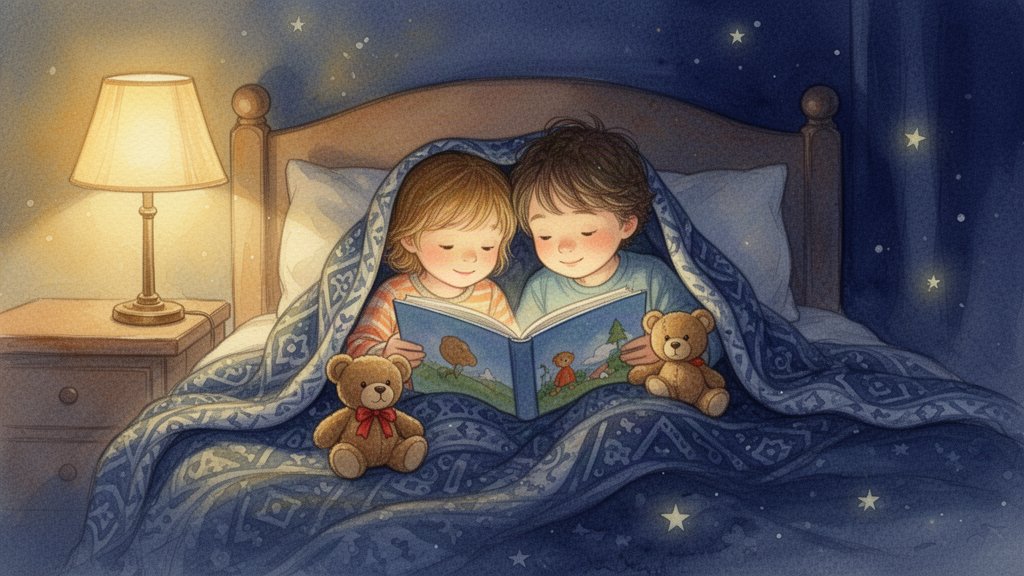
When two children share one story time, someone is always sitting too close, choosing the wrong book or turning the pages too slowly. Here is how to keep shared bedtime stories cosy, fair and (mostly) argument-free, whatever the age gap.
You settle onto the bed with a book, a child tucked under each arm, and for about eleven seconds it is perfect. Then one of them says "She's on my side of you," the other says "I wanted the dinosaur book," and somebody starts crying about who gets to turn the page. Sound familiar?
Shared story time is one of the loveliest things siblings can do together, but it is also a surprisingly common flashpoint. Two children means two sets of preferences, two attention spans and two very strong opinions about fairness. The good news is that a few small changes can turn the chaos into the cosiest part of the day.
Why Shared Story Time Gets So Tense
It helps to understand what is really going on. Squabbles at story time are rarely about the book. They are usually about one of three things:
- Attention. Story time is prime one-on-one time with you, and each child wants as much of it as possible.
- Control. Choosing the book, turning the pages and sitting in the best spot are small ways of feeling in charge at the end of a long day.
- Tiredness. By bedtime, self-control is at its lowest. A tiny annoyance that would be shrugged off at 3pm becomes a catastrophe at 7pm.
Knowing this means you can stop treating each argument as a one-off and start designing a story time that meets these needs before they turn into fights.
Set Up the Space Before the Story Starts
Many arguments can be prevented before you open the book. Try these small tweaks:
- Assign seats, then rotate them. A simple chart or "left side tonight, right side tomorrow" rule removes the nightly negotiation. Children accept a rule far more easily than a decision made in the moment.
- Give everyone a bit of personal space. A cushion, blanket or favourite cuddly on each lap creates a gentle boundary, especially for children who dislike being squashed.
- Dim the lights and lower your voice early. A calm atmosphere is contagious. If you start in a whisper, they are more likely to match you.
- Do the practical bits first. Pyjamas on, teeth brushed, water fetched. Nothing derails a story like someone needing the toilet halfway through.
Choosing the Story: Fair Systems That Work
The "what shall we read?" debate is the biggest culprit, so give it a clear system:
- Take turns by night. Monday is one child's pick, Tuesday is the other's. Write it on a calendar so nobody has to argue about whose turn it is.
- One each, with a limit. Each child chooses one short book, and that is the end. Agree this before you start, not after the tears.
- Use a "story jar." Write story ideas or book titles on slips of paper and let the children take it in turns to pull one out. Chance feels fairer than parental decree.
- Let the non-chooser have a job. The child who did not pick tonight might turn the pages, do the sound effects or choose which voice you use for the villain. Everyone gets a role.
Managing Different Ages and Attention Spans
An age gap makes things trickier. A two-year-old wants repetition and rhymes, while an eight-year-old wants plot and a bit of suspense. A few ways to bridge the gap:
- Pick books with layers. Many picture books work on two levels: simple pictures and rhythm for the little one, clever jokes or deeper themes for the older child.
- Ask the older child to be your helper. Let them point out things in the pictures for the younger sibling. It makes them feel capable rather than held back.
- Split the evening if you need to. A short picture book together, then ten minutes of a chapter book with just the older child while the little one settles. Older children often treasure this one-to-one time.
- Alternate the level. A "little one's choice" night and a "big kid's choice" night is perfectly fair, as long as both are genuinely respected.
Make It Personal for Both of Them
One reason siblings squabble is that a story can feel like it belongs to only one of them. Stories that include both children as characters can help enormously. You could make up a tale together where each child is a hero with their own part to play, or add their names to a familiar story as you read.
If you do not have the energy to invent one at the end of a long day, an app like Dreamtime can help. It creates a fresh bedtime story every night based on a child's name, age and interests, so you can set up a story each sibling will love, with its own watercolour illustrations and narration. Many parents find that a story made just for them makes children feel special, which takes the heat out of the "that one's yours, not mine" arguments.
What to Do When It All Still Goes Wrong
Even with the best planning, some nights will dissolve into squabbling. When that happens:
- Stay calm and brief. "I can see you are both upset. I will start again when we are all ready." Then wait quietly.
- Do not reopen the negotiation. Stick to the agreed system, even if there are tears. Consistency is what makes it work over time.
- Offer a gentle reset. A few deep breaths, a cuddle or a sip of water can reset frayed nerves.
- Save one-to-one time for another moment. If one child is craving your attention, a five-minute chat or cuddle at a different time of day can reduce competition at story time.
A Little Patience Goes a Long Way
Shared story time will not be perfectly peaceful every night, and that is fine. What your children are learning, while they argue over who sits where, is how to share, take turns and compromise, skills that will serve them well beyond the bedroom. With a clear system, a calm space and a story that feels like it belongs to everyone, those cosy moments under the covers will outnumber the squabbles. And years from now, they may well remember the shared stories, not the fights, as the best part of their childhood bedtimes.
Give your child a new story every night
Dreamtime creates personalised bedtime stories with beautiful illustrations, tailored to your child, every single night.
Start your free trial →