How to Help Your Child With Bedtime Perfectionism (When "I Didn't Do It Right Today" Ruins Sleep)
Dreamtime
27 August 2026
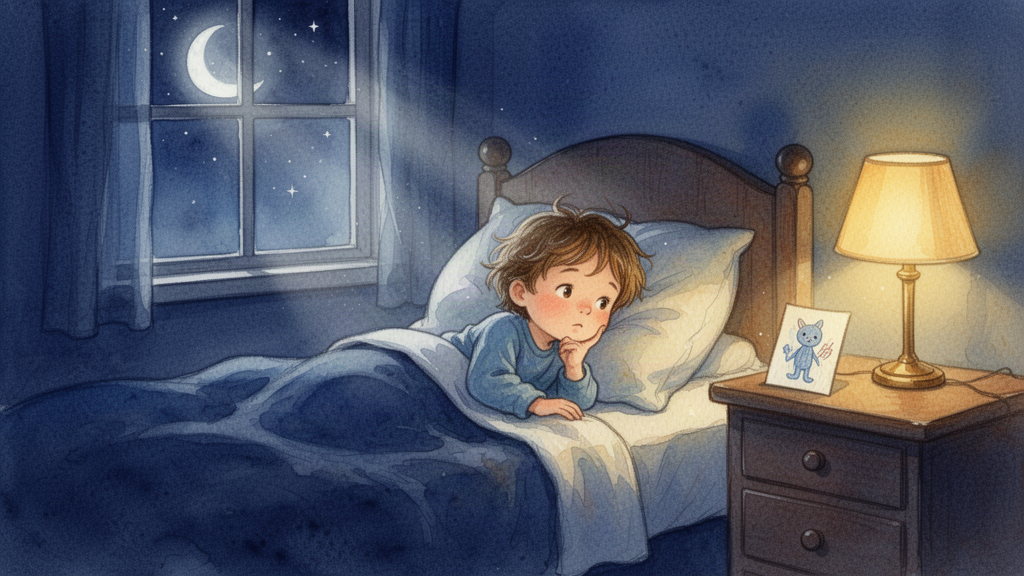
Some children can't settle at night because they're replaying every mistake from the day, from a wobbly drawing to a mispronounced word. Here's why perfectionism shows up at bedtime and how to help your child let go of the day without letting go of their standards.
Some children lie down at night and drift off within minutes. Others lie there replaying the moment they got a spelling wrong, tripped during football practice, or coloured "outside the lines." If your child seems to use bedtime as a private courtroom where they relitigate every small mistake from the day, you're not imagining it, and you're not alone. Perfectionism in young children is more common than most parents expect, and bedtime is often when it shows up loudest.
During the day, children are busy. There are distractions, friends, screens, snacks, the next activity always pulling attention forward. But at night, when the room goes quiet and the body finally slows down, the mind often does the opposite. It starts sorting through the day's leftover feelings, and for a child who holds themselves to a high standard, that sorting can turn into self-criticism. "I said the wrong answer in class." "I should have scored that goal." "My picture wasn't as good as hers." These thoughts can circle for a surprisingly long time, and they can genuinely delay sleep.
Why Perfectionism Shows Up More at Night
Children as young as four or five can already have a sense of "doing well" versus "getting it wrong," and by six or seven, many are comparing themselves to siblings, classmates, or an idealised version of themselves. During the day, this comparison often stays background noise. At bedtime, with nothing else competing for attention, it moves to the foreground.
There's also a physiological piece. As melatonin rises and the body starts winding down, emotional regulation actually gets a little harder, not easier. This is why small worries can feel disproportionately large right before sleep. A child who seemed perfectly fine at dinner can dissolve into tears over a maths question from hours earlier, simply because bedtime is when their brain finally has space to process it.
It helps to remember that this isn't your child being dramatic or difficult. It's a sign that they care, that they're paying attention to how they're doing in the world, and that they haven't yet learned how to hold a mistake lightly. That's a skill, and like any skill, it can be taught.
Separate the Mistake From the Story About the Mistake
When a child says "I did it wrong today," what they usually mean is "I am not good enough," and that leap from action to identity is where the real distress lives. Gently helping them separate the two can take the sting out considerably.
Try reflecting back the specific event without the judgement attached: "So you got one word wrong in your spelling test." Let that sit for a second before adding anything else. Often children will fill in the harsh part themselves ("...and that means I'm bad at spelling"), which gives you a clear opening to challenge it kindly: "One word wrong. How many did you get right?" You're not dismissing their feelings, you're just gently loosening the story they've attached to the facts.
Avoid rushing to reassure with "it doesn't matter" or "you're perfect." Children who are wired for perfectionism often don't believe blanket reassurance, and it can even feel like you're not taking them seriously. Specific, honest observations land better than general comfort.
Give Mistakes a Job to Do
Rather than trying to erase the mistake from your child's mind, try giving it a purpose. Ask what they might do differently next time, not as a punishment but as a genuinely curious question. "What do you think would help next time you're not sure of a spelling?" This reframes the mistake as information rather than a verdict, which is a much easier thing to fall asleep on.
Some families find it helpful to keep a small "letting go" ritual at bedtime: naming one thing that didn't go to plan, one thing that did, and then physically closing an imaginary box on the day. It sounds simple, but for a child whose brain won't stop circling, having a defined moment to "file away" the day can be genuinely calming.
Model Imperfection Out Loud
Children absorb far more from what we do than what we say, and perfectionism is often, at least partly, learned. If your child hears you narrate your own small mistakes with humour and ease, "Oops, I burned the toast again, oh well," it teaches them that mistakes are just part of being a person, not evidence of failure. Try sharing a small mistake of your own at bedtime occasionally: "I sent an email today with the wrong date in it. I fixed it and it was fine." Keep it light. You're not trying to teach a lesson, you're just modelling what it looks like to shrug something off.
Use Story Time to Practise Resilience Without the Pressure
Stories are a wonderfully low-stakes way for children to see characters mess up, feel bad about it, and recover, all without it being about them directly. A character who forgets their lines in the school play, or gets a puzzle wrong three times before solving it, gives your child a safe distance from which to process similar feelings of their own.
This is one area where personalising the story can help even more. When you use an app like Dreamtime to create a nightly story featuring your own child by name, facing something like a small mistake or a wobbly first attempt at something new, it can open the door to conversations that feel less direct and less like a lecture. Hearing "their" character make a mistake and be okay afterwards often lands more gently than a direct conversation about their actual day.
A Gentle Reminder for Perfectionist Parents Too
If bedtime perfectionism sounds familiar, it's worth a quick, kind check on whether it's a pattern in the household more broadly, not to blame anyone, but because children are remarkably good at noticing what we value. A home where effort and curiosity are celebrated as much as results tends to produce children who can rest easier at the end of the day, mistakes and all.
Perfectionism in young children isn't something to eliminate entirely. That same drive often grows into diligence, care, and pride in a job well done. The goal at bedtime isn't to talk your child out of caring, it's to help them hold their standards a little more loosely at the one time of day when their body most needs to rest. With patience, specific reassurance, and maybe a story or two along the way, most children do learn to let the day go, mistakes and all, and drift off feeling like enough exactly as they are.
Give your child a new story every night
Dreamtime creates personalised bedtime stories with beautiful illustrations, tailored to your child, every single night.
Start your free trial →