How to Help Your Child Stop Talking About What Happens to Their Toys "When They're Asleep" (And Other Bedtime Magical Thinking)
Dreamtime
15 September 2026
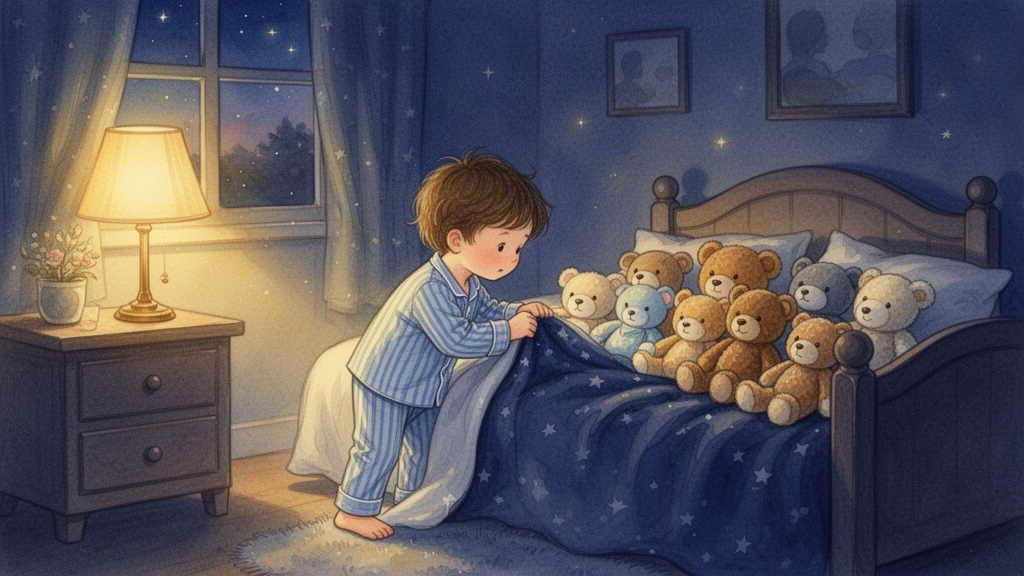
Does your child worry about their toys feeling lonely, or insist their stuffed animals need to be arranged "just so" before sleep? This kind of bedtime magical thinking is a completely normal part of development. Here's what's really going on, and how to work with it instead of against it.
"But what if Bunny gets cold while I'm asleep?" "Does Teddy know I still love him even though Panda is sleeping closer to me tonight?" "I have to say goodnight to all of them in the right order or it won't work."
If bedtime in your house involves a whole diplomatic negotiation with an army of stuffed animals, you're not dealing with a quirky one-off. You're witnessing a completely normal, and actually quite wonderful, stage of childhood thinking called magical thinking. It's the belief that toys have feelings, that thoughts can influence events, and that rituals carry real power. And while it can turn a five-minute goodnight into a twenty-minute ceremony, understanding why it happens makes it much easier to manage with patience instead of frustration.
Why Children Believe Their Toys Come Alive
Magical thinking typically peaks between ages 2 and 7, right in the sweet spot of early bedtime battles. At this age, children haven't yet developed a firm boundary between fantasy and reality. Their brains are wired for imaginative play, and that same wiring makes it genuinely hard for them to be certain that Bunny doesn't feel things.
This isn't a sign of anxiety or something to worry about. It's actually a marker of healthy cognitive and emotional development. Believing that objects have inner lives requires a child to imagine another perspective, which is an early building block of empathy. The same part of your child's brain that worries about a lonely teddy bear is the part that will one day help them comfort a real friend who's upset.
Toys also become emotional stand-ins. If your child is working through a big feeling, whether it's a new sibling, a house move, or simply the vulnerability of being left alone in a dark room, it's often easier to project that feeling onto a toy than to talk about it directly. "Teddy is scared of the dark" is frequently a child's way of saying "I am scared of the dark" without having to admit it out loud.
When It Turns Into a Stalling Tactic
Of course, savvy children quickly learn that "Piglet needs a blanket too" is an excellent way to buy another five minutes awake. The trick is telling the difference between genuine magical thinking and a stalling tactic dressed up in the same language.
A few signs it's more about delay than genuine belief:
- The requests escalate every night (one toy needing attention becomes ten)
- Your child seems calm and business-like about it rather than genuinely worried
- It only ever happens at bedtime, never at nap time or other transitions
If it seems like stalling, it helps to build the toy ritual into the routine itself rather than letting it open-endedly expand. Say something like, "Let's tuck in your three favourites together, then it's lights out for everyone, including you." Giving it a clear place in the routine, with a clear end point, respects the ritual without letting it swallow the whole evening.
How to Respond Without Dismissing Their World
It can be tempting to say "Don't be silly, it's just a toy," but this rarely helps and can make a child feel unheard. Instead, try meeting them inside their imaginative world for a moment before gently guiding them out of it.
Try phrases like:
- "I think Bunny feels very safe when he's tucked right in next to you."
- "Let's make sure everyone has a cosy spot, and then it's time for all of us, toys included, to rest."
- "What do you think would help Teddy feel better?" (This invites your child to solve the problem themselves, which is often more calming than you solving it for them.)
This approach validates the feeling behind the request without requiring you to stay up all night negotiating on behalf of a stuffed rabbit. It also quietly teaches emotional regulation. When your child figures out how to soothe Bunny's imagined worries, they're practising the exact skills they'll need to soothe their own.
Using Story Time to Work Through It
Story time is a brilliant, low-pressure way to help children process this stage without ever needing to have a serious sit-down chat about it. Stories where toys, animals, or objects have their own gentle nighttime routines can normalise the idea that "everyone" goes to sleep peacefully, toys included, which can quietly reassure a child who worries about their own belongings.
This is one area where a personalised story can do something a shelf of picture books can't. In Dreamtime, you can create a story where your own child, by name, helps their actual favourite toy get ready for bed, complete with watercolour illustrations that make it feel real and personal. Hearing their own worry gently mirrored and resolved in a story, with them as the confident hero who knows exactly how to help, can be far more reassuring than being told to hurry up and go to sleep.
When to Simply Let It Run Its Course
In most cases, this phase is not something to "fix." It fades naturally as children's understanding of the world matures, usually by age 7 or 8, when the line between imagination and reality becomes much clearer to them. Rather than trying to eliminate it, aim to contain it within a predictable, time-limited part of the routine, and use it as a window into what your child might be feeling more broadly.
If the worry about toys seems to be standing in for a bigger anxiety, such as separation, change at home, or fear of the dark, it's worth gently exploring that underlying feeling during the day, when there's no pressure to get to sleep.
A Small Ritual Worth Protecting
There's something quite lovely about a child who cares so much for an inanimate rabbit that they need to know it's warm enough. It's a sign of a big, generous imagination and a growing capacity for empathy, both things worth protecting even as you gently manage the time it takes. Give it a place in the routine, meet your child where they are, and trust that this particular bedtime negotiation, like so many others, is one you'll look back on fondly sooner than you think.
Give your child a new story every night
Dreamtime creates personalised bedtime stories with beautiful illustrations, tailored to your child, every single night.
Start your free trial →