How to Help Your Child Learn Empathy Through Different Kinds of Bedtime Characters
Dreamtime
21 August 2026
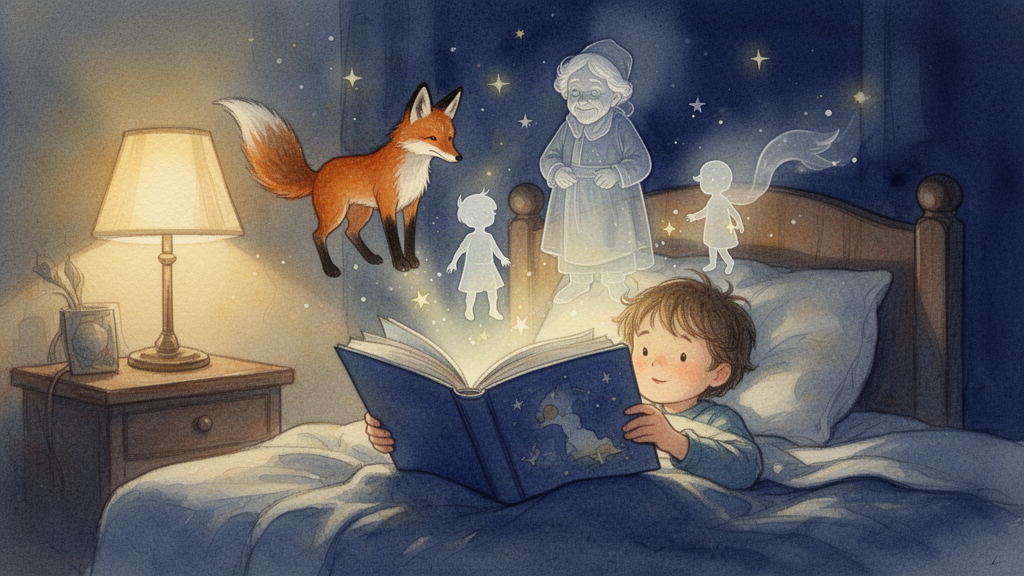
The characters your child meets at bedtime shape how they understand other people's feelings. Here's how to choose and talk about story characters in ways that gently build real-world empathy.
Long before a child can explain what empathy means, they're practising it every night at bedtime — through the characters in their stories. When your child worries about the lonely dragon, cheers for the shy new kid at school in the story, or feels a pang of sadness for the lost puppy, they're doing something remarkable: stepping outside their own perspective and into someone else's. This isn't a side effect of storytime. It's one of the most powerful tools we have for raising kind, emotionally aware children — and it starts with the characters we choose.
Why Characters Matter More Than Plot
Parents often focus on whether a story has an exciting plot or a satisfying ending, but when it comes to empathy-building, the characters are doing the heavy lifting. A well-drawn character with clear feelings — even a simple one, like a bear who's nervous about the first day of school — gives your child a low-stakes way to practise recognising and naming emotions.
This matters because empathy has two parts: understanding what someone else is feeling (cognitive empathy) and actually feeling something in response (affective empathy). Stories exercise both. When your child hears "the little fox's ears drooped and her tail went still," they're learning to read emotional cues. When they feel a lump in their throat because the fox is sad, they're practising the emotional response that turns understanding into compassion.
Research in developmental psychology has consistently shown that children who are read a wide variety of character-driven stories score higher on tests of "theory of mind" — the ability to understand that other people have thoughts and feelings different from their own. This skill underpins nearly everything about healthy social development, from making friends to resolving conflicts to standing up for others.
The Power of Character Variety
One of the simplest ways to boost empathy through storytime is to widen the range of characters your child encounters. It's easy to default to characters who are just like your child — same age, same interests, same kind of family — because they're instantly relatable. But real empathy growth happens at the edges of familiarity.
Try to include:
- Characters who are different ages — a grumpy teenager, a wobbly toddler, a wise grandparent — so your child learns that feelings look different at different life stages.
- Characters who struggle with something your child finds easy — a character who can't read yet, who's scared of water, or who finds it hard to share.
- Characters from different family shapes and backgrounds — this normalises diversity and helps children see kindness as something owed to everyone, not just people who look and live like them.
- Characters who make mistakes — a character who says something unkind and has to make it right teaches more about empathy than a character who's simply nice from page one.
You don't need an enormous library to do this. Even reusing familiar characters but placing them in new emotional situations — a favourite hero having a bad day, feeling jealous, or being excluded — opens up rich territory for empathy conversations.
Talking About Feelings Without Turning It Into a Lesson
The temptation, once you notice a story teaching empathy, is to hammer the point home: "And what do we learn from that, sweetheart?" Resist it. Children switch off the moment storytime starts to feel like school. Instead, keep your comments light, curious, and in the moment.
Try questions like:
- "How do you think she's feeling right now?"
- "Have you ever felt like that?"
- "What do you think would help him feel better?"
These questions do something quietly powerful: they ask your child to imagine themselves into another's shoes without ever using the word "empathy." Over weeks and months, this becomes a habit of mind rather than a lesson to be memorised.
It also helps to occasionally pause on the character's body language rather than just their words — "look at his face, what do you think that means?" — because so much of real-life empathy depends on reading expressions and tone, not just listening to what people say.
Letting Your Child Be the Character
One particularly effective technique is letting your child become the character facing the emotional dilemma, rather than just observing from the outside. When a child is the hero of the story — navigating a friend's hurt feelings, comforting a scared younger sibling character, or figuring out how to include someone who's left out — they process the emotional logic far more deeply than when they're a passive listener.
This is one of the reasons personalised stories can be such a valuable addition to a bedtime routine. Dreamtime, for instance, creates a new story each night starring your own child by name, and can weave in gentle social and emotional scenarios suited to their age — like a friend who's feeling left out, or a character learning to say sorry — so your child isn't just hearing about empathy, they're rehearsing it as themselves, in a story made just for them, complete with watercolour illustrations and narration.
Building the Habit Over Time
Empathy isn't built in a single bedtime story — it's built in hundreds of small moments, repeated over years. Some nights the lesson will land, other nights your four-year-old will be far more interested in the fact that the dragon can breathe fire. That's completely fine. The goal isn't for every story to be a teaching moment; it's for empathetic thinking to become a quiet, recurring thread woven through your family's storytelling life.
Keep an eye out, too, for real-world echoes — when your child spontaneously comforts a friend or notices someone's upset at nursery, gently connect it back: "That was a bit like when the fox helped her friend, wasn't it?" These bridges between story and life are where empathy truly takes root.
Bedtime will always be, first and foremost, about comfort, connection, and winding down for sleep. But within that cosy ritual lies a genuine opportunity: to raise a child who not only imagines dragons and distant planets, but who imagines, just as vividly, what it's like to be somebody else. Choose your characters with a little care, ask a few gentle questions, and you'll be surprised how much kindness can grow from a bedtime story.
Give your child a new story every night
Dreamtime creates personalised bedtime stories with beautiful illustrations, tailored to your child, every single night.
Start your free trial →